
In my experience, most assault charges brought in Colorado are for misdemeanor assault, also called third-degree assault under C.R.S. 18-3-204. Assault is prosecuted as a misdemeanor rather than a felony in one of three situations.
- The first type of misdemeanor assault is knowingly or recklessly causing another person to sustain a non-serious bodily injury. This means you knew – or realistically should have known – your actions would harm the victim and chose to ignore the risks.
- Example: You push someone out of the way during a heated argument at a bar, causing them to trip and bruise their arm. Even if you did not mean to hurt them, you should have known that pushing them could result in them sustaining injuries.
- The second type of misdemeanor assault is acting with criminal negligence when using a deadly weapon to cause a non-serious bodily injury to another person. This is more serious than acting accidentally: Your actions were a “gross deviation” from what a reasonable person would do.
- Example: Your friend asks to see your new folding knife. You toss it to them, but it opens and slightly cuts their finger. Even though you had no intent to harm your friend, throwing any weapon is a risk a reasonable person would avoid.
- The third type of misdemeanor assault pertains when you know the victim is a peace officer, firefighter, or emergency medical care/service provider. The criminal act is causing them to come into contact with bodily fluid/waste or a toxic, caustic, or hazardous material, and your purpose was to harass, annoy, threaten, or alarm them.1
- Example: You are at a protest and spit on a police officer who tells you to leave. Since you intended to annoy the officer and caused them to come into contact with your saliva, it counts as misdemeanor assault even though there was arguably no injury.
Note that for the first two types of misdemeanor assault, the victim needs to sustain a non-serious bodily injury, such as minor cuts or burns or even pain. If the victim sustains a serious bodily injury, then the D.A. would bring felony assault charges. Examples of serious bodily injury include fractures, paralysis, or permanent disfigurement.
Also note that for the second type of misdemeanor assault, which requires a deadly weapon, the weapon itself does not have to be a gun or knife. Everyday objects like pipes, belts, glass, or bricks can count as a deadly weapon if they are used in an injurious way.2
Penalties for Misdemeanor Assault
In Colorado, third-degree assault is classified as an extraordinary risk class 1 misdemeanor. The maximum sentence is up to 18 months in the county jail and/or fines of up to $1,000.3
While jail time is a possibility, many first-time offenders I see receive probation instead. Probation typically includes a course of anger management classes plus paying medical restitution to the victim.
Defenses to Misdemeanor Assault
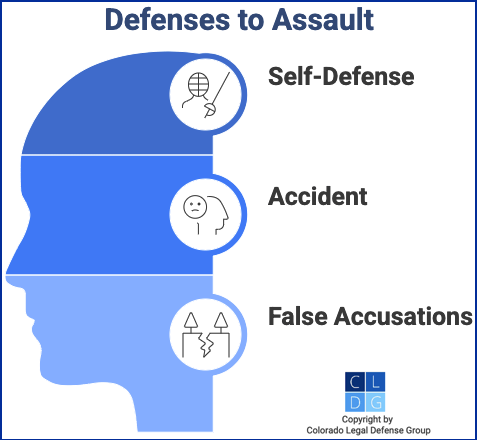
Being charged with third-degree assault in Colorado does not mean you will be convicted. There are three strong ways to fight back in court:
- You acted in lawful self-defense. You may use proportional physical force to defend yourself (or someone else) if you reasonably believe that someone else is about to use unlawful physical force against you (or someone else).4
- The incident was an accident. Sometimes unfortunate things happen with no one to blame. As long as prosecutors cannot prove beyond a reasonable doubt that you acted knowingly, recklessly, or with criminal negligence, you did not commit assault.
- You were falsely accused. I sometimes see cases where people (often vengeful exes) actually harm themselves and then accuse my clients of injuring them just to get them into trouble. Fortunately, there are expert witnesses who can often identify self-inflicted wounds.
Frequently Asked Questions
Can a misdemeanor assault charge affect my right to own a gun?
Yes, it can. Under federal law, if your third-degree assault charge is classified as an act of domestic violence (meaning it involved a spouse, intimate partner, or co-parent), a conviction will permanently strip away your constitutional right to own or purchase a firearm.
What happens if the alleged victim wants to drop the charges?
This is a very common misunderstanding. In Colorado, the victim does not have the power to drop the charges; only the District Attorney (the prosecutor) can do that.
Even if the victim begs the prosecutor to dismiss the case, the state can still force the case forward using other evidence, like police body-cam footage or 911 audio.
Will a misdemeanor assault stay on my record forever?
Colorado law does allow you to petition the court to seal a third-degree assault conviction. You generally must wait at least three years after your case (and probation) ends, as long as you do not pick up any new criminal charges during that waiting period.
If you take no action, your third-degree assault conviction should be automatically sealed seven years after the case closes. Note that if your charge gets dismissed, you can petition for a seal immediately.
Additional Resources
If you want to learn more about the rules and court procedures surrounding criminal charges in our state, please explore these helpful resources:
- Colorado Revised Statutes – Read the exact wording of state criminal laws.
- Colorado Judicial Branch FAQs – Find answers about basic court procedures, what to wear, and how to act in front of a judge.
- Colorado General Assembly – Track newly passed bills and see how lawmakers are changing criminal sentencing rules this year.
Legal References
- C.R.S. 18-3-204. See, for example, People. v. Honstein (Colo. 2024) 549 P.3d 970; People v. Wade (Colo. App. 2024) 548 P.3d 1164.
- C.R.S. 18-1-901.
- See note 1.
- C.R.S. 18-1-704.