
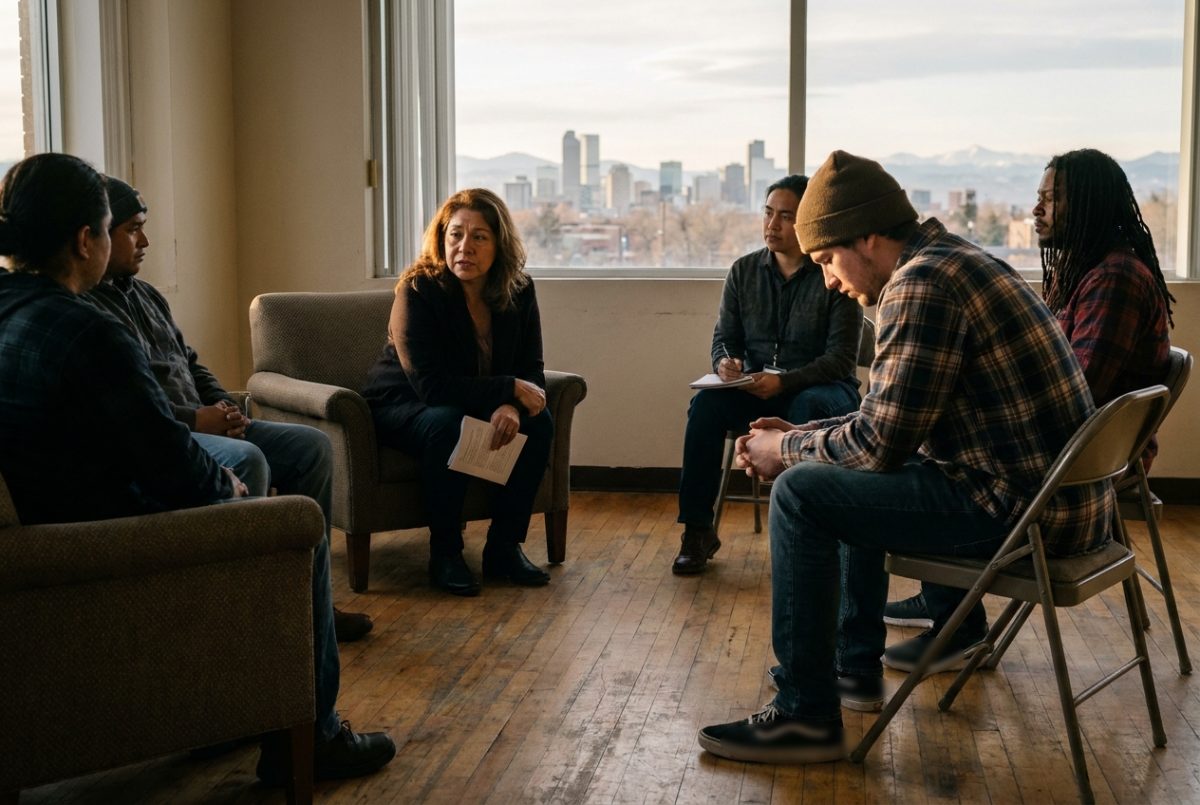
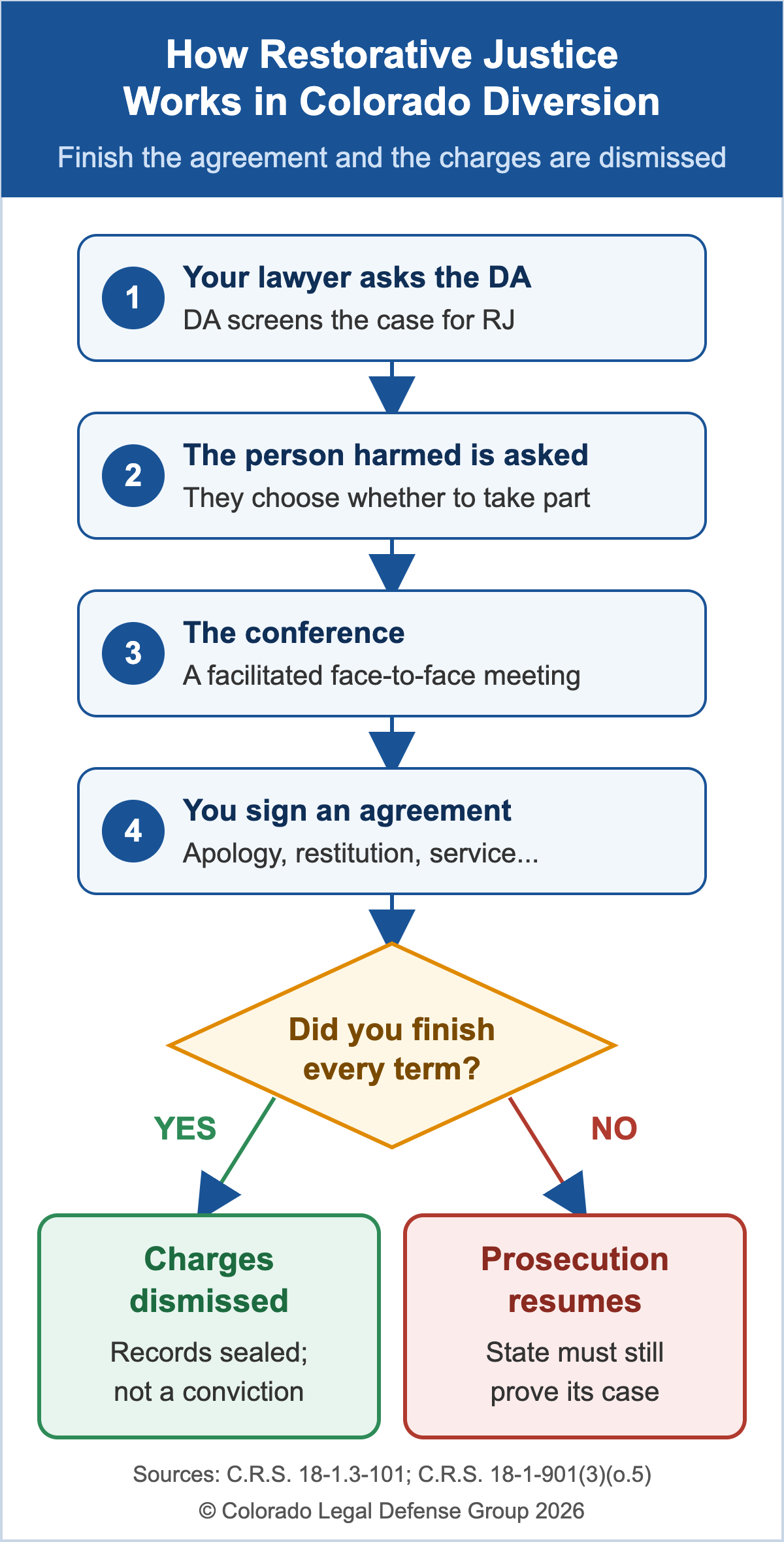
Restorative justice in Colorado is a facilitated meeting where the person accused of a crime and the person harmed talk about what happened and agree on how to repair it. When it is part of pretrial diversion, finishing the agreement gets the charges dismissed and the records sealed. When a judge orders it as part of a sentence, the conviction stays.
Example: Jordan, 19, is charged with misdemeanor theft for taking $300 of tools from a neighbor’s garage in Aurora. The DA offers diversion with restorative justice. Jordan meets the neighbor with a facilitator, pays the $300 back, writes an apology and does 20 hours of community service. When Jordan finishes, the court dismisses the case.
In this article, our Colorado criminal defense lawyers answer six questions about restorative justice:
- What is restorative justice in Colorado?
- When can restorative justice happen in a Colorado case?
- Who is eligible?
- What happens at a restorative justice conference?
- What do you agree to do?
- What happens when you finish, or don’t?
What is restorative justice in Colorado?
In Colorado, restorative justice (often shortened to “RJ”) means practices that focus on repairing the harm an offense caused to the victim and the community. The law lists victim-offender conferences, family group conferences, circles and community conferences as examples.1
Two features set it apart from a normal court case:
- It is voluntary for the person harmed. They choose whether to attend, and they can bring supporters.
- You must take responsibility. The meeting only works if you are willing to own what happened and help repair it.
Restorative justice is most often offered as one form of adult diversion in Colorado, which keeps a case out of court if you meet set conditions.
When can restorative justice happen in a Colorado case?
In Colorado, restorative justice can come up at three different points, and the result for your record depends on which one:
- Adult pretrial diversion. Colorado’s diversion statute lets DA diversion programs use restorative justice, and a diversion agreement can require you to take part in it.2 This is the version that ends in a dismissal.
- Juvenile cases. On a young person’s first juvenile petition, the DA may decide whether they are suitable for restorative justice. The DA may offer to dismiss the charges if they complete it, with the court’s approval.3 Our page on the Denver juvenile court explains the rest of the process.
- Sentencing. After a conviction, a judge can send some defendants to a restitution and community service program that includes restorative justice, as an alternative sentence. Here the conviction remains on your record.4
Who is eligible for restorative justice in Colorado?
There is no right to restorative justice in Colorado. The DA decides whether to offer it, and the person harmed has to be open to it. Each DA’s office also sets its own program rules, so eligibility varies by county.
Charges Colorado law rules out
Colorado statutes set a few firm limits:
- At sentencing: restorative justice is not available if you were convicted of unlawful sexual behavior, a crime involving domestic violence, stalking or violating a protection order.5
- In state-funded diversion: serious sex offenses, such as sexual assault and sexual assault on a child, are barred. Other domestic violence and sex-offense cases can be considered only after charges are filed and you complete a specialized evaluation.6
Cases DAs tend to consider
In our experience, DAs are most open to restorative justice for first-time, lower-level cases with a clear person to make amends to, such as misdemeanor theft, criminal mischief (property damage), burglary and harassment. Adults can take part as well as juveniles.
How to ask
Have your lawyer raise it with the DA. In juvenile cases, Colorado law says the young person must ask the DA or the program, and may not ask the victim directly.7 For many crimes, the DA’s office must also tell victims that restorative justice is available.8
What happens at a restorative justice conference?
A Colorado restorative justice conference is a meeting led by a trained facilitator, often in a community room rather than a courtroom. The usual flow:
- Preparation. The facilitator meets each side separately first.
- The meeting. You, the person harmed, supporters for each of you and sometimes community members sit together. Each person speaks, and the person harmed explains how the offense affected them.
- The agreement. The group agrees on what you will do to repair the harm, and you sign it.
If the person harmed doesn’t want to attend, a juvenile conference can go ahead with a stand-in, and the victim can submit a written statement instead.9
Example: Maya, 15, spray-paints a school wall in Lakewood. The principal doesn’t want to attend, so a victim advocate stands in and reads the principal’s statement. Maya agrees to repaint the wall and write an apology.
When a judge orders a victim-offender conference at sentencing, the facilitator’s fee is capped at $125 on a sliding scale, and the court can waive it. What you say there is confidential: it can’t be used to charge or prosecute you unless you commit a new offense during the conference.10
What do you agree to do in Colorado restorative justice?
The agreement is built around the harm in your case. Colorado law names apologies, community service, reparation, restoration and counseling as examples.11 Common terms include:
- paying restitution for the loss,
- a spoken or written apology,
- community service, sometimes chosen by the person harmed,
- repairing or replacing damaged property, and
- counseling or classes.

What happens when you finish restorative justice, or don’t?
In Colorado, the result depends on the stage where restorative justice happened.
If you finish it as part of diversion
When you complete a diversion agreement, the court must dismiss all charges with prejudice, meaning they can’t be refiled. The case doesn’t count as a conviction, and the court must seal the arrest and court records.12 Colorado’s adult diversion programs report that only 1% of people who successfully completed diversion in fiscal year 2024 picked up new charges within a year.13
Do you have to plead guilty?
No. Colorado can’t require a plea as a condition of pretrial diversion. But the agreement can include a written statement of the facts, and if you fail diversion, the prosecutor can use that statement to impeach you (challenge your testimony) at trial.14
If you don’t finish
If you break the agreement, the DA can revoke diversion and resume the prosecution.15 You are back where you started: the presumption of innocence still applies, and the prosecution must prove every element of the charge beyond a reasonable doubt.16
If restorative justice was part of your sentence
The conviction stays on your record. Finishing the program completes that part of your sentence.17
Restorative justice FAQ
Can the person harmed refuse restorative justice?
Yes. In Colorado, restorative justice meetings are attended voluntarily by the victim. In juvenile cases a stand-in can take their place, and the victim can send a written statement.
Does restorative justice cost anything in Colorado?
Program fees vary by county. If a judge orders a victim-offender conference at sentencing, the facilitator’s fee is capped at $125 on a sliding scale and can be waived. Separately, every adult convicted of a crime in Colorado pays a $10 restorative justice surcharge that funds RJ programs, unless the court finds they can’t afford it.18
Does restorative justice clear my record?
Only when it is part of pretrial diversion. Then the charges are dismissed and the records sealed. Restorative justice ordered at sentencing follows a conviction, which stays on your record.
Talk to a Colorado criminal defense lawyer
If you’ve been charged with a crime in Colorado, a lawyer can tell you whether restorative justice or diversion is realistic in your county and ask the DA for it on your behalf. Contact Colorado Legal Defense Group for a free consultation.
Additional resources
- Find restorative justice providers: Restorative Justice Colorado’s statewide search of programs.
- Restorative Denver: the Denver District Attorney’s restorative justice program, run with the Conflict Center.
- Colorado Restorative Justice Coordinating Council: the state council’s page at the Colorado Judicial Branch.
- Colorado Circles for Change: a Denver nonprofit that runs restorative programs for young people.
Legal references:
- C.R.S. 18-1-901(3)(o.5): “‘Restorative justice practices’ means practices that emphasize repairing the harm caused to victims and the community by offenses. Restorative justice practices include victim-offender conferences, family group conferences, circles, community conferences, and other similar victim-centered practices. Restorative justice practices are facilitated meetings attended voluntarily by the victim or victim’s representatives, the victim’s supporters, the offender, and the offender’s supporters and may include community members.”
- C.R.S. 18-1.3-101(8), (9)(b): “Diversion programs may include, but are not limited to, … restorative justice programs …”; diversion agreements may include “participation in restorative justice practices as defined in section 18-1-901 (3)(o.5) ….”
- C.R.S. 19-2.5-502(2): “If the petition is the first juvenile petition filed against the juvenile in any jurisdiction and is initiated in a jurisdiction that has restorative justice practices available, the district attorney or the district attorney’s designee may determine whether the juvenile is suitable for restorative justice practices. … The district attorney may offer dismissal of charges as an option for the successful completion of these and any other conditions …, subject to approval by the court.”
- C.R.S. 18-1.3-104(1)(b.5)(I): a defendant may “be sentenced to a specialized restitution and community service program …, which may include restorative justice practices ….”
- C.R.S. 18-1.3-104(1)(b.5)(I) (see note 4 above): “To be eligible for restorative justice practices, the defendant shall not have been convicted of unlawful sexual behavior …, a crime in which the underlying factual basis involves domestic violence …, stalking …, or violation of a protection order ….”
- C.R.S. 18-1.3-101(5)-(7) (see note 2 above): in programs receiving state money, a person accused of domestic violence or a sex offense “is not eligible for pretrial diversion unless charges have been filed, the individual has had an opportunity to consult with counsel, and the individual has completed” an approved evaluation; persons accused of listed sexual offenses, including sexual assault and sexual assault on a child, are “not eligible.”
- C.R.S. 19-2.5-502(2) (see note 3 above): “If a juvenile wants to participate in restorative justice practices, the juvenile shall make the request to the district attorney or the law enforcement agency administering the program and may not make the request to the victim.”
- C.R.S. 24-4.1-303(11)(g): “The district attorney shall inform a victim of … (g) The availability of restorative justice practices …, which includes victim-offender conferences.”
- C.R.S. 19-2.5-502(2) (see note 3 above): “If a victim elects not to attend, a victim-offender conference may be held with a suitable victim surrogate or victim advocate, and the victim may submit a victim impact statement.”
- C.R.S. 18-1.3-104(1)(b.5)(I) (see note 4 above): “the facilitator of the conference shall provide his or her services for a fee of no more than one hundred twenty-five dollars, based on a sliding scale; however, the fee may be waived by the court. Any statements made during the conference shall be confidential and shall not be used as a basis for charging or prosecuting the defendant unless the defendant commits a chargeable offense during the conference.”
- C.R.S. 18-1-901(3)(o.5) (see note 1 above): the participants “agree on consequences to repair the harm, to the extent possible, including but not limited to apologies, community service, reparation, restoration, and counseling.”
- C.R.S. 18-1.3-101(10)(b), (c) (see note 2 above): “the court shall dismiss with prejudice all charges against the defendant. … A successfully completed diversion agreement shall not be considered a conviction for any purpose.”; “At any point after a diversion agreement is completed, the court shall seal all arrest and other criminal records pertaining to the offense ….”
- Colorado Judicial Department, Adult Diversion Program Annual Legislative Report, Fiscal Year 2024, p. 2: “Only 1% of successful participants incurred new charges within one year.”
- C.R.S. 18-1.3-101(9)(d), (e) (see note 2 above): the defendant’s statement of facts “is admissible as impeachment evidence against the defendant in the criminal proceedings if the defendant fails to fulfill the terms of the diversion agreement”; “A defendant shall not be required to enter any plea to a criminal charge as a condition of pretrial diversion.”
- C.R.S. 18-1.3-101(10)(d) (see note 2 above): “The district attorney, in his or her sole discretion, may initiate revocation of a diversion agreement ….”
- COLJI-Crim. E:03 (2025): “Every person charged with a crime is presumed innocent. … The prosecution must prove to the satisfaction of the jury beyond a reasonable doubt the existence of each and every element necessary to constitute the crime charged.”
- C.R.S. 18-1.3-104(1)(b.5)(I) (see note 4 above): restorative justice at this stage is part of a sentence “to a specialized restitution and community service program,” imposed after conviction.
- C.R.S. 18-25-101(1)(a), (4): “Each person who is convicted of a crime is required to pay a ten-dollar surcharge ….”; “The court may waive all or any portion of the surcharge … if the court finds that a person is indigent or financially unable to pay ….” See also Waddell v. People, 2020 CO 39, ¶ 22, 462 P.3d 1100 (the restorative justice surcharge is mandatory).