
Quick summary
A Colorado advisement hearing (also called a “hearing on advisement“) is your first court date after an arrest. The judge tells you your rights and the charges, sets bond and asks about a lawyer. If you are held in jail, Colorado law requires it within 48 hours of your arrival.
- No plea yet: You don’t plead guilty or not guilty at an advisement. That happens later, at the arraignment.
- Bond: Colorado judges must presume you can be released on the least restrictive conditions, and they must consider your finances.
- Lawyer: You can ask for a public defender at the advisement if you can’t afford a lawyer.
- Example: Dana is arrested Friday night in Denver. By Sunday she sees a judge by video from the jail, hears her rights and gets a personal recognizance bond. No charges are filed yet.
In this article, our Colorado criminal defense lawyers answer 9 common questions about advisement hearings in Colorado criminal court:
- 1. What is an advisement hearing?
- 2. What happens at the first advisement?
- 3. What is a second advisement?
- 4. Is an advisement the same as an arraignment?
- 5. Do I get a lawyer at my advisement?
- 6. How is bond set at an advisement?
- 7. Can I get my bond lowered?
- 8. What happens after the advisement?
- 9. Advisement hearing FAQs
1. What is an advisement hearing?
In Colorado, an advisement hearing is the first time a person who has been arrested appears before a judge. Colorado’s court rules require that anyone arrested, with or without a warrant, be taken before a county or district court “without unnecessary delay.”1 The word “advisement” comes from what happens there: the judge advises you of your rights and the accusation against you.
What the judge must tell you
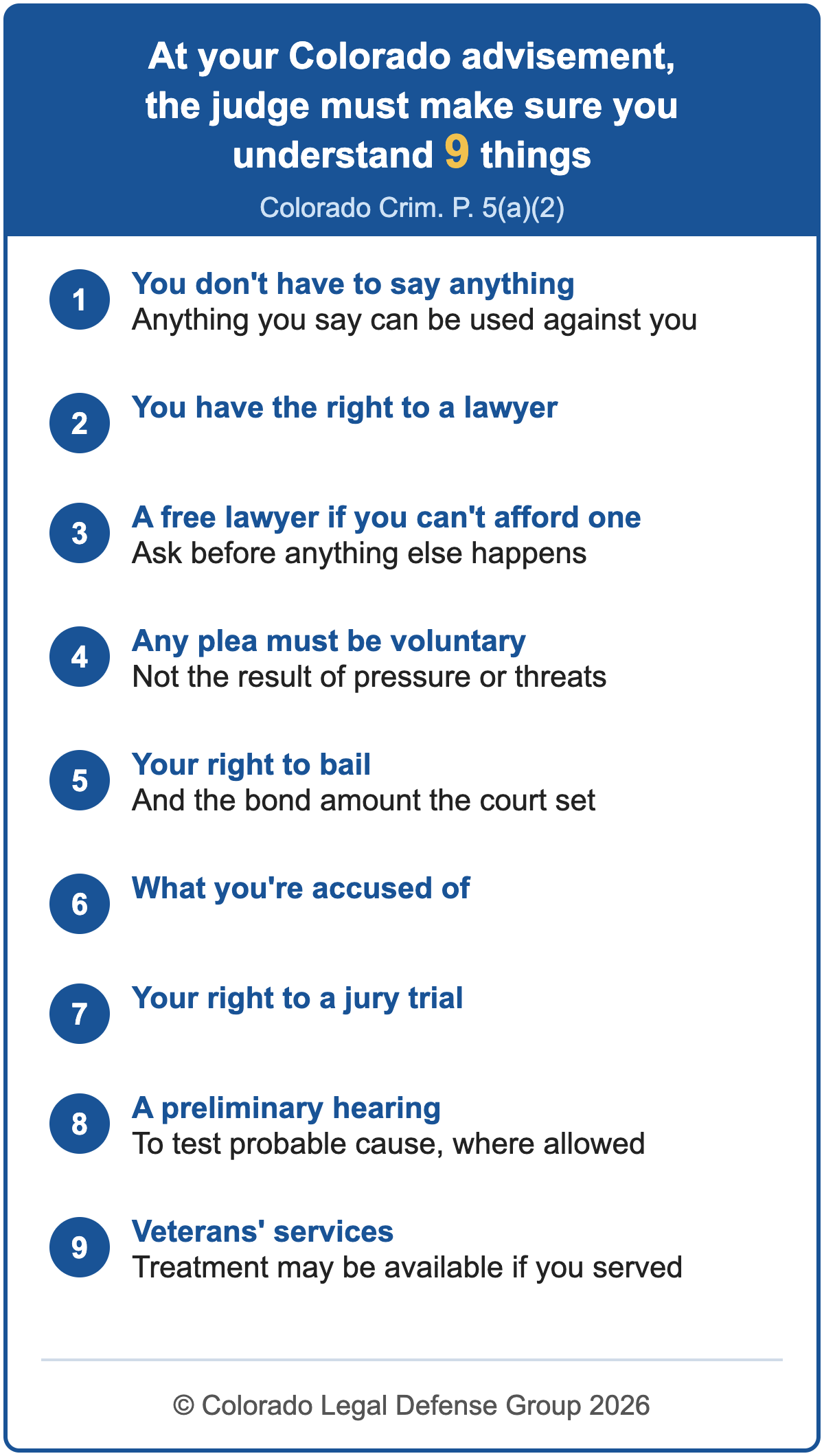
Under Colorado Rule of Criminal Procedure 5, the judge must make sure you understand these rights at your first appearance:2
- You don’t have to make a statement, and anything you say can be used against you.
- You have the right to a lawyer.
- If you can’t afford a lawyer, you can ask for one to be appointed or talk with the public defender before anything else happens.
- Any plea you make must be voluntary.
- You have the right to bail if the offense is bailable, and the court tells you the amount.
- The nature of the charges.
- Your right to a jury trial.
- Your right to ask for a preliminary hearing within a reasonable time, where the law allows one.
- If you are serving in or are a veteran of the U.S. armed forces, you may be entitled to mental health, substance use or other veterans’ services.
Other names for the same hearing
Colorado court dockets and jail records use several labels for this first court date:
- “Hearing on advisement” or “advisement”: the most common label on Colorado dockets.
- “First appearance”: the term used in Rule 5 and in Colorado’s bail statutes.
- “Appearance on bond” or “bonded advisement”: usually the first court date for someone who already posted bond and was released before seeing a judge. The judge gives the same advisement of rights and charges.
- “ADV” in “CJC”: in El Paso County, “ADV” on a court schedule means advisement, and “CJC” is the Criminal Justice Center, the county jail in Colorado Springs, where in-custody advisements are held by video.3
Being advised of charges is not evidence of guilt
Hearing a judge read a charge can feel like a verdict. It isn’t. Colorado’s model jury instruction tells jurors that “the charge against the defendant is not evidence” and is “just an accusation.”4 Every person charged with a crime in Colorado is presumed innocent unless the prosecution proves guilt beyond a reasonable doubt.5
2. What happens at the first advisement?
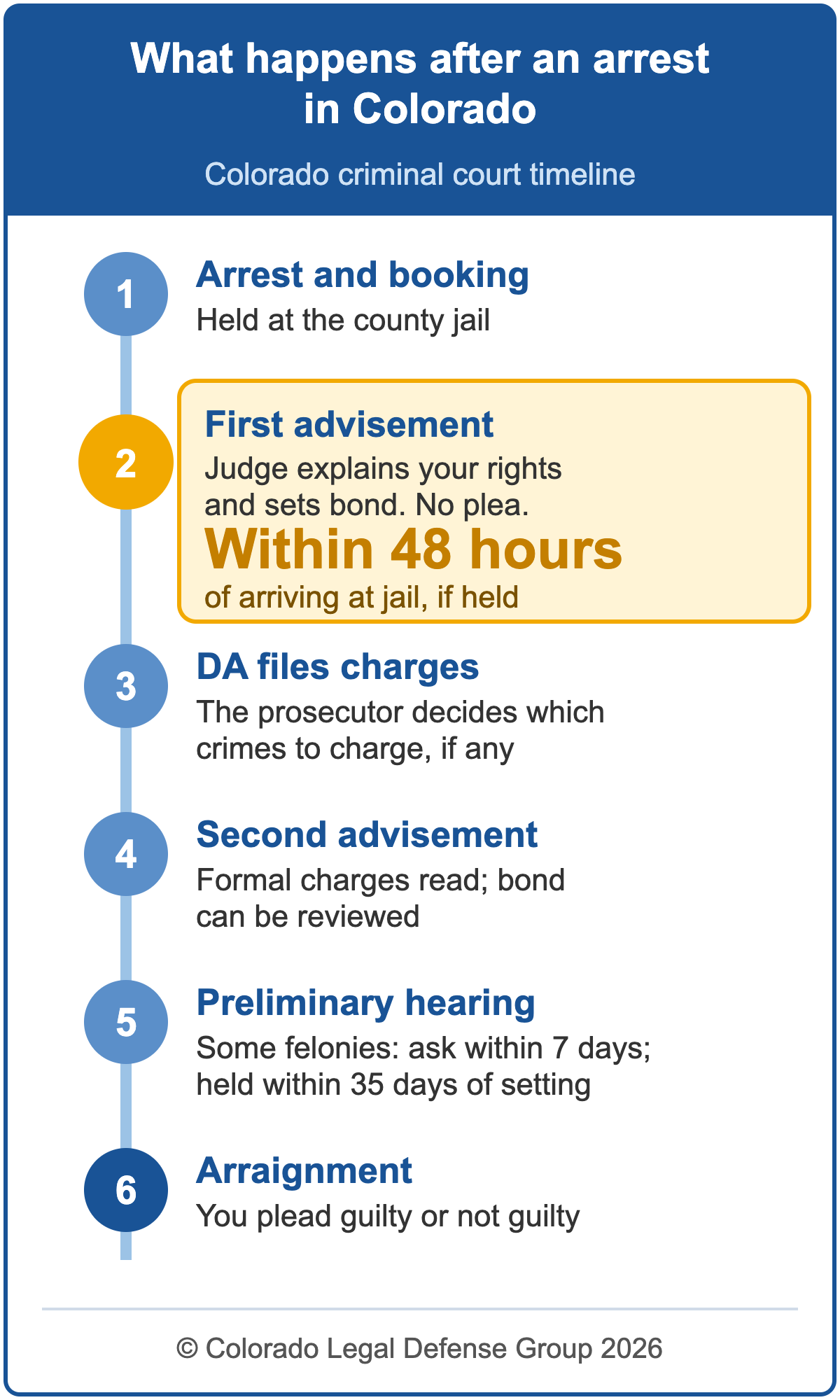
In Colorado, the first advisement usually happens soon after an arrest, often before the district attorney (DA) has filed formal charges. If you are held in jail, Colorado law requires that you be brought before a court for bond setting no later than 48 hours after you arrive at the jail, and the judge must enter an individualized bond order.6 These hearings can happen on weekends, and many counties hold them by video from the jail.

What happens during the hearing
A typical first advisement in Colorado is short, often just a few minutes. The judge will usually:
- Tell you that you are being held on suspicion of certain offenses (the DA may not have decided which charges to file yet).
- Read you your rights, as listed in section 1.
- Ask whether you have a lawyer, plan to hire one or want a public defender.
- Set the type of bond and the conditions of release.7
- Tell you about any protection order and your next court date.
A protection order starts at the advisement
In every Colorado criminal case, a mandatory protection order takes effect when you are advised of your rights at your first appearance or arraignment. It bars you from harassing, intimidating, retaliating against or tampering with any witness or alleged victim, and it lasts until the case ends.8 In domestic violence cases, the order often also bars all contact and can keep you out of your home. Read it carefully: violating a protection order is a separate crime.
Don’t talk about the facts
The judge will tell you that anything you say can be used against you. Take that seriously. The advisement is not the place to explain your side of the story. In our experience, statements people make at a first advisement, often while scared and sleep-deprived, are some of the hardest for a defense lawyer to undo later. Answer the judge’s questions about your name, address and lawyer, and save the facts for a private conversation with your attorney.
Example: Marcus is arrested in Aurora for alleged assault. At his video advisement, he starts telling the judge the other man swung first. The judge stops him and reminds him he has the right to remain silent. The prosecutor in the courtroom heard every word.
3. What is a second advisement?
In many Colorado counties, including Denver, a second advisement takes place after the DA formally files charges. At the second advisement, the judge tells you the specific crimes you are charged with and gives you a copy of the complaint or information.9 The judge can also review your bond at this hearing. If the charges filed are less serious than the arrest charges, that can be a reason to ask for a lower bond.
In Denver, the District Attorney’s Office says it generally must file charges within three business days of the arrest when the person is in custody, though extensions are possible.10 Timing varies in other counties.
Not every county holds two advisements. In some, the first appearance and the filing of charges are combined. And if you were given a summons instead of being arrested, your first court date may simply be your advisement on the charges already filed.
Example: Leo is arrested in Denver on suspicion of felony theft and has a first advisement the next morning. Three days later, the DA files a misdemeanor theft charge instead. At his second advisement, Leo’s lawyer asks the judge to lower his bond because the charge is now a misdemeanor.
4. Is an advisement the same as an arraignment?
No. In Colorado, an advisement and an arraignment are different hearings, even though people often mix up the terms. Colorado law defines an arraignment as calling the defendant into open court, informing them of the charge “and the entry of a plea to the charge.”11 The advisement comes earlier and has no plea.
Here is how the two hearings compare:
| Advisement hearing | Arraignment | |
|---|---|---|
| When | First court date, usually within days of arrest (within 48 hours of arriving at jail if held) | Weeks or months later, after charges are filed (and after any preliminary hearing in felony cases) |
| Purpose | Explain your rights and the accusation; set bond | Formally read the charges and take your plea |
| Plea entered? | No | Yes: guilty, not guilty or another plea the law allows |
| Bond | Set or reviewed | Can be reviewed on request |
| Lawyer | You can ask for a public defender | You should have a lawyer by now |
The arraignment is also where plea negotiations often come to a head. Before you enter any plea, talk with your lawyer about the evidence, your defenses and what a plea bargain would really mean for you. Prosecutors sometimes make a first offer that is far worse than the case deserves.
5. Do I get a lawyer at my advisement?
You have the right to a lawyer in every Colorado criminal case that can lead to jail, and the U.S. Supreme Court has held that this right attaches at your first appearance. In Rothgery v. Gillespie County, the Court held that the first appearance before a judicial officer, “where he learns the charge against him and his liberty is subject to restriction,” starts the adversary process that triggers the Sixth Amendment right to counsel.12
Hiring a lawyer vs. getting a public defender
If you already have a private lawyer, they can appear with you at the advisement and argue for a lower bond. If you can’t afford a lawyer, you can ask the judge to appoint the Colorado State Public Defender. Eligibility depends on your income, expenses and assets under guidelines set by the Colorado Supreme Court, and you will be asked to fill out a financial application.13 In some counties, a public defender is present at in-custody advisements; in others, a lawyer is appointed after the hearing. Learn more about public defenders in Denver.
Why it helps to have a lawyer early
We often see bond set lower when a lawyer is at the first advisement with proof of the person’s job, home and family ties. An early lawyer can also start gathering evidence, contact witnesses before memories fade and begin talking with the prosecutor before charges are filed. You don’t need a lawyer for the advisement itself to go forward, but you should not enter any plea without one.
6. How is bond set at an advisement?
In Colorado, the judge sets the type of bond and conditions of release at your first appearance if you are in custody.14 Bond (also called bail) is a promise, sometimes backed by money or property, that you will come back to court and follow the conditions of release.
The presumption of release
Colorado law requires judges to presume that every person in custody is eligible for release on bond with “the appropriate and least-restrictive conditions.” Any money condition must be reasonable, and other conditions must be tailored to a specific concern.15 The bond must be enough to reasonably ensure you come to court and to protect public safety, taking into account your individual characteristics, including your financial condition.16
For some low-level charges, money bail isn’t allowed at all. A Colorado court cannot impose a monetary condition of release for a traffic offense, a petty offense or a comparable municipal offense.17
Types of bond in Colorado
Colorado judges can choose among these types of bond:18
- Personal recognizance (PR) bond: you sign a promise to appear and pay nothing up front. You owe the bond amount only if you miss court. Learn more about getting out of jail without a bail bond.
- PR bond with conditions: the same, plus conditions such as pretrial supervision, check-ins, no alcohol or electronic monitoring.
- Secured (cash, property or surety) bond: you or someone for you posts the full amount in cash, puts up Colorado real estate or uses a licensed bail bond company, which charges a nonrefundable fee.
If you get a PR bond, Colorado law says the jail must release you as soon as practicable and, unless extraordinary circumstances exist, no later than 6 hours after you are back at the jail.19
What the judge considers
Besides your finances, a Colorado judge may consider factors such as:20
- Your job and work history.
- Your family relationships.
- Where you live now and have lived.
- Your character and reputation.
- People who will help you get to court.
- The likely sentence for the charge.
- Your criminal record and any past missed court dates.
- Any facts suggesting you might break the law or intimidate witnesses if released without conditions.
- Anything else showing strong ties to the community.
When bail can be denied
Most people in Colorado have a constitutional right to bail. The main exceptions are first-degree murder charges when “proof is evident or presumption is great,” and certain crimes of violence (such as a new violent crime while on probation, parole or bail for an earlier one) after a hearing held within 96 hours of arrest.21
The first-degree murder exception comes from Amendment I, which voters approved in 2024. In People v. Rodriguez-Nunez, a Colorado Court of Appeals division held in 2026 that it applies only to murders committed on or after December 17, 2024. A person charged with a first-degree murder committed between July 1, 2020, and that date keeps the right to bail.22
7. Can I get my bond lowered?
Yes. In Colorado, either you or the DA can ask the court to change bond at any point while the case is pending. The judge can lower or raise the money amount, drop or add security, or change other conditions.23 Your lawyer can ask for a bond change at the first or second advisement, at the arraignment or in a written motion for a bond hearing.

What helps a bond reduction
A defense lawyer can ask for a lower bond or a PR bond by showing that you will come to court and won’t be a danger. Useful evidence includes:
- Pay stubs or a letter from your employer.
- A lease, mortgage statement or other proof of where you live.
- Family members in court who can confirm your ties to Colorado.
- Proof that you care for children or a sick family member.
- A clean record of showing up to past court dates.
- Your finances, if you simply can’t pay the amount set.
Judges must explain high money bonds
A Colorado judge can set a money bond you can’t afford, but only with factual findings showing the amount and type are reasonable and necessary. In Rodriguez-Nunez, the Court of Appeals sent a $5 million cash bond back to the trial court partly because the judge made no findings explaining why that bond was needed.24
Example: Sofia gets a $10,000 cash bond at her first advisement in Adams County. Her lawyer files a motion with her pay stubs, her lease and a letter from her children’s school. At the bond hearing, the judge changes it to a PR bond with pretrial check-ins.
8. What happens after the advisement?
After the advisement, a Colorado misdemeanor case usually moves toward the arraignment and plea negotiations. A felony case may go first to a preliminary hearing or a dispositional hearing, depending on the charge. See our guide to the Colorado criminal court process.
Preliminary hearing
A preliminary hearing is where a county court judge decides whether there is probable cause to believe you committed the felony charged. Probable cause is a low standard; it is far below proof beyond a reasonable doubt. You have the right to a preliminary hearing in Colorado if you are charged with:25
- A class 1, 2 or 3 felony, or a level 1 or 2 drug felony.
- A class 4, 5 or 6 felony, or a level 3 or 4 drug felony, that requires mandatory sentencing, is a crime of violence or is a sexual offense.
- Any other class 4, 5 or 6 felony or level 3 or 4 drug felony if you are in custody for it (the court can cancel the hearing if you are released before it).
Either side must ask for the preliminary hearing within 7 days after you appear in county court on the felony complaint. The hearing must then be held within 35 days of being set, unless there is good cause for a delay.26 At the hearing, you don’t enter a plea, your lawyer can cross-examine the prosecution’s witnesses and present evidence, and the prosecution has the burden of showing probable cause.27 If the judge finds probable cause, the case is bound over to district court for arraignment.
Dispositional hearing
If you are charged with a lower-level felony and aren’t entitled to a preliminary hearing, you will usually have a dispositional hearing instead, unless you waive it. It is a meeting in court to evaluate the case and try to resolve it.28
Arraignment and beyond
At the arraignment, you enter your plea. From there, the case moves to motions hearings, plea negotiations and, if there’s no deal, a trial. If you are convicted or plead guilty, the case ends with sentencing. Throughout the case, you must follow every bond condition. Missing court or breaking a condition can lead to a warrant, bond revocation and new charges for violating bail conditions.
9. Advisement hearing FAQs
What does “hearing on advisement” mean in Colorado?
In Colorado criminal court, a “hearing on advisement” is the first court date after an arrest. The judge explains your rights and the accusation, asks about a lawyer and sets bond. You do not enter a plea at this hearing.
What does “appearance on bond” mean in Colorado?
In Colorado, “appearance on bond” usually refers to the first court date for someone who posted bond and was released before seeing a judge. At that hearing, the judge advises you of your rights and the charges and reviews your bond conditions.
What does “ADV” at “CJC” mean on an El Paso County court schedule?
In El Paso County, Colorado, “ADV” means advisement and “CJC” is the Criminal Justice Center, the county jail in Colorado Springs. People held there attend their advisement by video from the jail.
Do I have to plead guilty or not guilty at my advisement?
No. In Colorado, you don’t enter a plea at an advisement hearing. Your plea is entered later, at the arraignment, ideally after you have talked with a lawyer about the evidence and your options.
How soon after an arrest is the advisement in Colorado?
If you are held in jail in Colorado, the law requires a bond hearing no later than 48 hours after you arrive at the jail, with limited exceptions for emergencies. If you were released or given a summons, your advisement date will be on your paperwork.
Talk to a Colorado criminal defense lawyer
If you or a loved one has an upcoming advisement hearing anywhere in Colorado, call Colorado Legal Defense Group for a free consultation. We can appear at the hearing, argue for a lower bond and start building your defense right away.
Legal references:
- Colo. Crim. P. 5(a)(1): “If a peace officer or any other person makes an arrest, either with or without a warrant, the arrested person shall be taken without unnecessary delay before the nearest available county or district court.” (Rule current as of October 12, 2026.)
- Colo. Crim. P. 5(a)(2) (see note 1 above for the source): “At the first appearance of the defendant in court, it is the duty of the court to inform the defendant and make certain that the defendant understands the following: (I) The defendant need make no statement and any statement made can and may be used against the defendant; (II) The right to counsel; (III) If indigent, the defendant has the right to request the appointment of counsel or consult with the public defender before any further proceedings are held; (IV) Any plea the defendant makes must be voluntary and not the result of undue influence or coercion; (V) The right to bail, if the offense is bailable, and the amount of bail that has been set by the court; (VI) The nature of the charges; (VII) The right to a jury trial; (VIII) The right to demand and receive a preliminary hearing within a reasonable time to determine whether probable cause exists to believe that the offense charged was committed by the defendant; (IX) If currently serving in the United States armed forces or if a veteran of such forces, the defendant may be entitled to receive mental health treatment, substance use disorder treatment, or other services as a veteran.”
- Colorado Judicial Branch, 4th Judicial District, FAQ for Video Advisements (current as of July 10, 2025): “CJC stands for Criminal Justice Center and it is the jail in El Paso County.”
- COLJI-Crim. E:02 (2025) (The Charge Against the Defendant): “The charge against the defendant is not evidence. The charge against the defendant is just an accusation. The fact that the defendant has been accused is not evidence that the defendant committed any crime.” The 2025 edition, published February 25, 2026, is the current edition (checked against the Reporter’s Online Update of October 30, 2026).
- COLJI-Crim. E:03 (2025) (Presumption of Innocence, Burden of Proof, and Reasonable Doubt): “Every person charged with a crime is presumed innocent.”
- C.R.S. 16-4-102(2)(a)(I): “The arresting jurisdiction shall bring an in-custody arrestee before a court for bond setting as soon as practicable, but no later than forty-eight hours after an arrestee arrives at a jail or holding facility. A judge, magistrate, or bond hearing officer shall hold a hearing with an in-custody arrestee at which the court shall enter an individualized bond order . . . .” The statute excuses delays caused by court-closing emergencies or when the person refuses or is unable to attend.
- C.R.S. 16-4-103(1)(a): “At the first appearance of a person in custody before any court or any person designated by the court to set bond, the court or person shall determine the type of bond and conditions of release . . . .”
- C.R.S. 18-1-1001(1): the mandatory protection order “remains in effect from the time that the person is advised of the person’s rights at arraignment or the person’s first appearance before the court and informed of such order until final disposition of the action.”
- Colo. Crim. P. 5(a)(1) (see note 1 above): after an arrest, “a felony complaint, information, or indictment shall be filed, if it has not already been filed, without unnecessary delay in the proper court and a copy thereof given to the defendant.”
- Denver District Attorney’s Office, How Criminal Cases Work (accessed November 21, 2026; the page no longer loads in a browser): the DA “must generally file charges within three business days of the arrest when the defendant is in custody.”
- C.R.S. 16-1-104(2): “‘Arraignment’ means the formal act of calling the defendant into open court, informing him of the offense with which he is charged, and the entry of a plea to the charge.”
- Rothgery v. Gillespie County, 554 U.S. 191, 213 (2008): “a criminal defendant’s initial appearance before a judicial officer, where he learns the charge against him and his liberty is subject to restriction, marks the start of adversary judicial proceedings that trigger attachment of the Sixth Amendment right to counsel.”
- Colorado Chief Justice Directive 04-04 (Appointment of State-Funded Counsel in Criminal Cases, as amended; Attachment B amended March 2026); see also C.R.S. 21-1-103.
- C.R.S. 16-4-103(1)(a) (see note 7 above).
- C.R.S. 16-4-103(4)(a) (see note 7 above): the court shall “[p]resume that all persons in custody are eligible for release on bond with the appropriate and least-restrictive conditions . . . . A monetary condition of release must be reasonable, and any other condition of conduct not mandated by statute must be tailored to address a specific concern.”
- C.R.S. 16-4-103(3)(a) (see note 7 above): “The type of bond and conditions of release shall be sufficient to reasonably ensure the appearance of the person as required and to protect the safety of any person or the community, taking into consideration the individual characteristics of each person in custody, including the person’s financial condition.”
- C.R.S. 16-4-113(2)(a): “For a defendant charged with a traffic offense, a petty offense, or a comparable municipal offense, a court shall not impose a monetary condition of release.”
- C.R.S. 16-4-104(1) (unsecured personal recognizance bond; personal recognizance bond with nonmonetary conditions; bond with secured monetary conditions posted by cash, Colorado real estate or a compensated surety).
- C.R.S. 16-4-102(2)(e) (see note 6 above): “Unless extraordinary circumstances exist, the custodian of a jail shall release a defendant who is granted a personal recognizance bond as soon as practicable but no later than six hours after the defendant is physically present in the jail.”
- C.R.S. 16-4-103(5)(a)-(j) (see note 7 above).
- Colo. Const. art. II, § 19(1) (bail exceptions, including (1)(b), crimes of violence after a hearing “held within ninety-six hours of arrest,” and (1)(d), “murder in the first degree . . . when proof is evident or presumption is great”).
- People v. Rodriguez-Nunez, 2026 COA 48, ¶ 7, 594 P.3d 209: “a person charged with first degree murder after the death penalty’s repeal on July 1, 2020, but who committed the offense before Amendment I took effect on December 17, 2024, retains the right to bail.”
- C.R.S. 16-4-109(1): “Upon application by the district attorney or the defendant, the court before which the proceeding is pending may increase or decrease the financial conditions of bond, may require additional security for a bond, may dispense with security theretofore provided, or may alter any other condition of the bond.”
- Rodriguez-Nunez, 2026 COA 48, ¶¶ 22, 26 (see note 22 above): “Without findings, we cannot determine how the court’s cash bond decision was ‘tailored to address a specific concern’ . . . or ‘reasonable and necessary’ . . . .”
- Colo. Crim. P. 5(a)(4) (see note 1 above).
- Colo. Crim. P. 5(a)(4)(I) (see note 1 above): “Within 7 days after the defendant is brought before the county court for or following the filing of the felony complaint in that court, either the prosecutor or the defendant may request a preliminary hearing. . . . The hearing shall be held within 35 days of the day of setting, unless good cause for continuing the hearing beyond that time is shown to the court.”
- Colo. Crim. P. 5(a)(4)(II) (see note 1 above): “The defendant shall not be called upon to plead. The defendant may cross-examine the prosecutor’s witnesses and may introduce evidence. The prosecutor shall have the burden of establishing probable cause.”
- Colo. Crim. P. 5(a)(4) (see note 1 above): “Any person accused of a class 4, 5, or 6 felony or a level 3 or 4 drug felony who is not entitled to a preliminary hearing shall, unless otherwise waived, participate in a dispositional hearing for the purposes of case evaluation and potential resolution.”