
It depends on the felony. Colorado’s POWPO law – which stands for “possession of a weapon by a previous offender” – prohibits you from possessing weapons (which probably includes crossbows) for any purpose if you have been convicted of certain serious felonies, but not all felonies.
For example, POWPO does not apply if your felony conviction was for grand theft or trespass. Meanwhile, POWPO does apply to you if your conviction was for any crime related to domestic violence, even if it was just a misdemeanor.1
In sum, you may possess a crossbow in Colorado as long as your prior convictions are not covered by POWPO (you can see the full list of POWPO crimes here). Though before you take your crossbow out hunting, be sure to check with Colorado Parks and Wildlife: There are many rules and regulations regarding licenses, seasons, and what type of game you can hunt.
Overview of “Felon in Possession” Laws
If you are convicted of certain serious felonies (or misdemeanors related to domestic violence), you may not possess prohibited weapons such as firearms in Colorado. State law is unclear whether this also includes crossbows, though my guess is that it does since crossbows are very deadly.
Possession of a weapon by a previous offender (“POWPO”) under C.R.S. 18-12-108 is generally a class 5 felony, carrying:
- 1 to 3 years in prison (with two years mandatory parole) and/or
- a fine of $1,000 to $100,000.
The judge can grant you probation unless you used – or threatened the use of – a firearm in the commission of another crime.2
POWPO-Prohibited Weapons
If POWPO applies to you, you may not possess any type of firearm (such as pistols, revolvers, shotguns, and rifles). It does not matter if the firing mechanism is broken. It also does not matter whether you are using the guns for hunting.3
I could make a strong legal argument that POWPO does not prohibit crossbow possession. After all, the statute never mentions it. Though a conservative reading of the law does suggest that POWPO covers all deadly weapons, which certainly includes crossbows.
Do I need a license to hunt in Colorado?
Yes, you need a license from Colorado Parks and Wildlife to hunt lawfully in Colorado. Interestingly, this government agency does not run criminal background checks on applicants.
Therefore, you may obtain a hunting license if you have been convicted of serious felonies or domestic violence-related misdemeanors. However, having a hunting license does not mean you can violate POWPO by possessing a weapon, even for hunting purposes.
Therefore, if you press your luck and hunt with a crossbow despite your criminal record, you risk getting caught and convicted of POWPO. This would add another felony to your criminal record.4
Can I avoid POWPO with a pardon?
You can try to restore your right to possess weapons by applying for a Governor’s Pardon. However, pardons are typically available only if you finished your criminal sentence at least ten years earlier. Even then, there is no guarantee that a pardon will be granted.5
The following graphic shows the most important factors that determine whether you may be granted a Governor’s Pardon in Colorado.
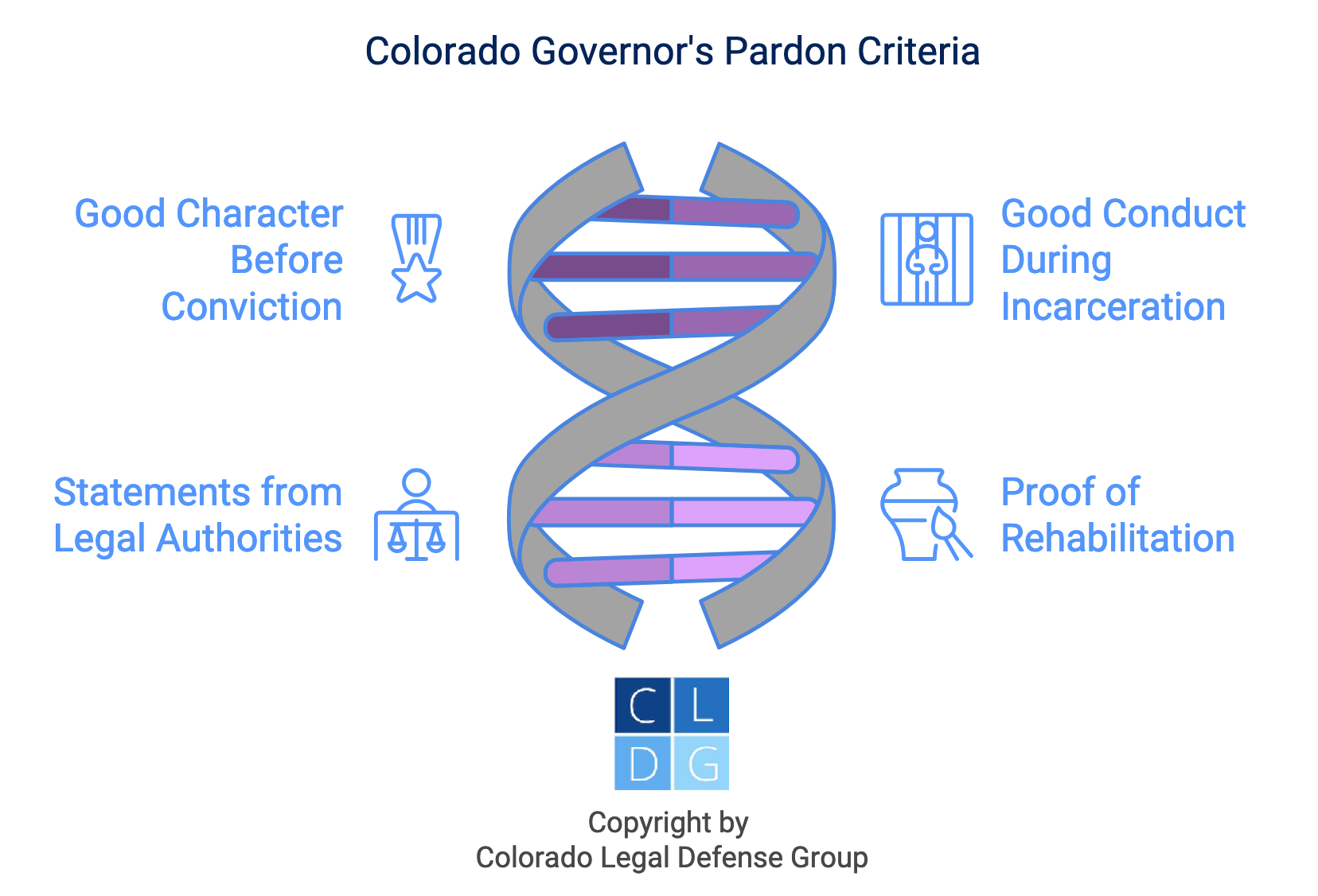
Learn more about applying for a Colorado Governor’s Pardon.
How do crossbows work?
Crossbows consist of a “prod” that is mounted perpendicularly to a “tiller.” The weapon shoots projectiles called bolts or quarrels, which are similar to arrows.
Crossbows have a lock to hold back the bowstring. This is unlike bows and arrows, which require the user to manually pull back and hold the bowstring. So all crossbow users need to do to release the bowstring is depress a trigger similar to a gun’s.
What about federal law?
Federal law prohibits the possession of firearms by people convicted of:
- any felony or
- any domestic violence crime, felony or misdemeanor.
This federal law bans the possession of only guns, not other weapons such as crossbows. Therefore, a person with a crossbow could be violating Colorado’s POWPO law without also violating federal law.6
Additional Resources
For more information, see these articles from the Colorado Department of Wildlife website.
- Hunting – Overview of Colorado’s hunting laws.
- Parks and Wildlife Regulations – Links to all the relevant hunting statutes.
- Youth Hunting – Rules for hunters 17 and younger.
- Hunters in the Military – Hunting programs and privileges for current and former members of the armed forces.
- Purchase License – Buy a hunting license online.
Legal References:
- C.R.S. 18-12-108 (“A person commits the crime of possession of a weapon by a previous offender if the person knowingly possesses, uses, or carries upon his or her person a firearm as defined in section 18-1-901(3)(h) or any other weapon that is subject to the provisions of this article 12 subsequent to the person’s conviction for a felony crime as defined in section 24-4.1-302(1) or listed in subsection (7) of this section, or subsequent to the person’s conviction for attempt or conspiracy to commit a crime as defined in section 24-4.1-302(1) that is a felony, pursuant to Colorado or any other state’s law or pursuant to federal law.”).
- Same.
- People v. O’Neal (Colo. App.2009) 228 P.3d 211, rehearing denied, certiorari denied 2010 WL 1436208.
- See Ryan Parker, “Felons set sights for hunting in Colorado,” The Denver Post (April 30, 2016).
- Clemency, Colorado Department of Corrections.
- 18 U.S. Code § 922(g).