


Nevada Revised Statute 486.231 requires motorcycle drivers and passengers to wear helmets approved by the U.S. Department of Transportation. If the motorcycle has no transparent windscreen, drivers and passengers must also wear googles, glasses, or face shields.1
Failure to wear a helmet on a motorcycle is a civil infraction carrying two demerit points by the Nevada Department of Motor Vehicles as well as a monetary penalty that varies by location.2 For example, Las Vegas Municipal Court charges $195 while Reno Municipal Court charges $80.

In this article, our Las Vegas criminal and personal injury attorneys will discuss the following key topics regarding Nevada motorcycle helmet laws:
- 1. Helmet Standards
- 2. Defenses
- 3. Reductions or Dismissals
- 4. DMV Points
- 5. Insurance
- 6. Traffic School
- 7. Ignoring Your Ticket
- 8. CDLs
- 9. Out-of-State Licenses
- 10. Record Seals
- 11. Immigration Consequences
- 12. Fighting vs. Paying
- 13. Why to Hire an Attorney
- 14. Can helmet-less victims sue?
- 15. Related traffic violations
- Frequently Asked Questions
- Additional Reading
1. Helmet Standards
You can still be cited for an NRS 486.231 violation if your motorcycle helmet does not meet the following six standards as outlined by the Nevada Department of Transportation (DOT) and National Highway Traffic Safety Administration (NHTSA):
- The helmet weighs a minimum of three (3) pounds.
- The helmet has an inner liner comprised of a minimum one-inch thick layer of firm polystyrene foam.
- The helmet has strong chin straps with secure rivets.
- Any extra components (such as ornaments) extend no further than two-tenths of an inch from the surface of the helmet.
- The helmet has a label by the manufacturer indicating its name, model type, year, and materials.
- The helmet has a sticker on the back imprinted with “DOT,” which certifies compliance with the Federal Motor Vehicles Safety Standards.3
2. Defenses
Here at Las Vegas Defense Group, we have represented literally thousands of people charged with traffic offenses, including motorcycle infractions. In our experience, the following three defenses have proven very effective with Nevada prosecutors and judges at getting NRS 486.231 charges reduced or dismissed.
- The vehicle was not a motorcycle. Nevada law does not require helmets for bicycles.4
- The vehicle was not on a public road. Nevada law requires helmets on motorcycles only on public roadways, such as city streets and highways.5
- You were falsely accused. Sometimes, people levy false accusations against others out of rage or revenge, and we can often find evidence of their motivation to lie by poring over their recorded communications such as texts and voicemails.
Typical evidence we rely on in these cases includes photographs, surveillance video, and eyewitness testimony.
Note that it is not a defense that the requirement to wear a helmet impinges on your constitutional rights.6

Not wearing a motorcycle helmet is a civil infraction under NRS 486.231.
3. Reductions or Dismissals
If you have a clean or minimal driving record, you have a very good chance of getting a Nevada motorcycle helmet charge dismissed or reduced to a non-moving violation. Prosecutors do not want to go to trial, so they are usually amenable to hammering out a favorable settlement for you.
4. DMV Points
Not wearing a motorcycle helmet causes two demerit points to go on your Nevada driver’s license. These points go away once one year has passed.
You are not in danger of losing your license unless you accumulate 12 or more demerit points. At that point, the DMV will suspend your license for six months. Even then it may be possible to fight the suspension at a DMV hearing, which is similar to a trial but on a tinier scale.7
5. Insurance
Not wearing a helmet while riding a motorcycle in Nevada usually results in higher insurance premiums. That is why you should fight your case in pursuit of a charge dismissal, which should have no insurance consequences.
6. Traffic School
Nevada judges usually require just a monetary civil penalty to close out a motorcycle helmet case. However, if you agree to do traffic school, the judge may be more willing to reduce the charge to a non-moving violation. This, in turn, may prevent
- insurance rate increases and
- demerit points.8
7. Ignoring Your Ticket
In Nevada, you can be assessed a late penalty if you do not pay your citation. The Nevada DMV may also suspend your license.9
8. CDLs
The Nevada DMV treats commercial driver’s licenses (CDLs) and non-commercial licenses the same. Therefore, you will have two demerit points added to your CDL for not wearing a motorcycle helmet.10
9. Out-of-State Licenses
Every state’s DMV has its own rules and regulations. Therefore, if you are an out-of-towner cited in Nevada for wearing no motorcycle helmet, you should consult with an attorney in your home state for more information.
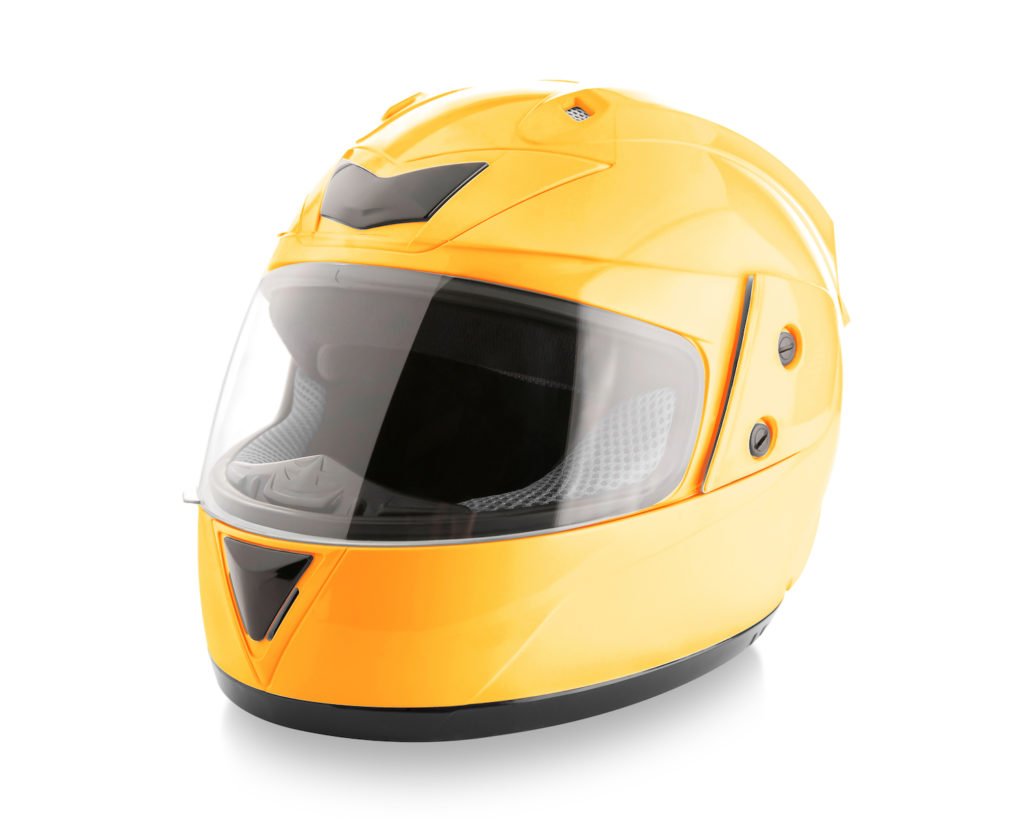
Motorcycle helmets must meet NHTSA and DOT regulations.
10. Record Seals
Civil infractions do not go on your criminal record. (Though if you fail to pay the penalty, a civil judgment can show up on your record.)
If your case was a misdemeanor from before January 1, 2023, you can seal the conviction one year after the case ends. Charges that got dismissed can be sealed right away.
Civil infractions do go on your DMV driving record, and there is no way to seal this.11
11. Immigration Consequences
Neglecting to wear a helmet while riding a motorcycle is not a deportable offense.
That being said, immigration law is in a precarious state. So, immigrants facing charges should still seek legal counsel, no matter how minor the charges are.
12. Fighting vs. Paying
Even though violating NRS 486.231 is not a major charge, it still is worth fighting the case. The D.A. may agree to dismiss the charge. If so, you may escape getting
- demerit points and
- a higher insurance premium.
You can request a hearing to contest the citation. In practice, these cases rarely reach that point.12
13. Why to Hire an Attorney
Hiring private counsel is always a wise idea for three reasons:
- Defense attorneys are familiar with the local prosecutors and judges, and they know which strategies to use to coax out the best resolutions possible.
- Prosecutors are more willing to reduce or dismiss charges when counsel represents you.
- If you lawyer up, you usually never have to see the inside of a courtroom again because the attorney can appear in court for you.
14. Can helmet-less victims sue?
If you were not wearing a motorcycle helmet and get into an accident in Nevada, you can still recover compensatory damages from the other driver as long as you were no more than 50% at fault for your injuries. Furthermore, your damages will be reduced in proportion to your degree of fault.13
Example: John is driving a motorcycle without a helmet on the Strip. Jim is driving his SUV drunk and hits John. John sues Jim for violating Nevada’s negligence laws, and the case goes to trial.
The judge orders Jim to pay all of John’s medical expenses related to his pelvis but only half the medical expenses related to his brain. The judge’s reasoning is that John’s pelvis injuries would have been just as severe even if John had been wearing a helmet. However, John was half as responsible for the extent of his brain injuries for not wearing a helmet and therefore deserves half the damages.
If the judge found that John was more than 50% at fault for his head injuries, he would recover nothing for his head injuries.
Learn more about Nevada’s modified comparative negligence laws.
15. Related Traffic Violations
- Not Wearing a Seat Belt (NRS 484D.495) – Not wearing a seat belt carries a maximum $25 civil penalty and no demerit points. However, a first-time offense of improperly securing a child in a car seat carries up to a $500 civil penalty or 50 hours of community service.
- No Due Care to Bicyclists (NRS 484B.270) – Failing to exercise due care to a cyclist is a misdemeanor if you cause an accident. A first-time offense carries a fine of $250 to $1,000. Additionally, the DMV adds four demerit points to your license.
- Texting While Driving (NRS 484B.253) – Texting while operating a vehicle is a civil infraction. The first offense carries a $50 civil penalty. A successive offense carries a $100 civil penalty as well as four driver’s license demerit points.14

Nevada motorcycle drivers and passengers must wear helmets even if there is no traffic or slow traffic.
Frequently Asked Questions
Can I still win a personal injury lawsuit if I wasn’t wearing a helmet?
Yes, but your compensation may be reduced—or eliminated entirely—based on Nevada’s “50% Rule” (modified comparative negligence).
If you are injured by a negligent driver while riding without a helmet, a jury will assign a percentage of fault to both parties. If the jury decides that your failure to wear a helmet makes you 51% or more responsible for the severity of your injuries (such as severe head trauma), you will recover nothing. If you are 50% or less at fault, your damages will simply be reduced by your assigned percentage of fault.
Will I get a criminal record for riding without a helmet?
No. Prior to 2023, riding without a helmet was a misdemeanor offense. However, under current Nevada law, failing to wear a motorcycle helmet is now classified as a civil infraction. While you will be issued a citation, required to pay a civil penalty, and receive two demerit points on your driver’s license, it will not result in jail time or a criminal record.
I am visiting from a state without helmet laws. Do I still have to wear one in Nevada?
Yes. Nevada’s traffic laws apply to anyone riding within state lines, regardless of where your motorcycle is registered or where your driver’s license was issued. Being an out-of-state visitor unaware of the local statute is not a valid legal defense against an NRS 486.231 citation.
Does my passenger have to wear a helmet even if they aren’t driving?
Yes. Nevada law explicitly states that both the driver and the passenger of a motorcycle or moped must wear a U.S. Department of Transportation (DOT) approved helmet securely fastened to their head while riding on public roadways.
Do I have to wear a helmet when riding a moped in Nevada?
Yes. Nevada law (NRS 486.231) explicitly requires both drivers and passengers of mopeds to wear U.S. Department of Transportation (DOT) approved helmets while riding on public roadways. While older versions of the statute contained an exception for mopeds, the Nevada Legislature updated the law to firmly close this loophole. Just like with a motorcycle, failing to wear a helmet on a moped is a civil infraction that will result in a fine and two demerit points on your driver’s license.
Do I need a helmet to ride an electric bicycle (e-bike) or e-scooter?
Under Nevada state law, adults are not required to wear helmets while riding electric scooters or Class 1 and Class 2 e-bikes. However, state law does mandate that all operators and passengers of Class 3 e-bikes (which can reach up to 28 mph) must wear a properly fastened bicycle helmet.
Additionally, riders should be aware of strict new local ordinances passed in late 2025. Jurisdictions including Clark County, the City of Las Vegas, and Boulder City now legally require all minors (under age 18) to wear helmets when riding any e-bike, e-scooter, or standard bicycle. Citations for minors riding without a helmet are civil infractions, and the parents or guardians are held financially responsible for the fines.
Additional Reading
For more in-depth information, refer to these scholarly articles:
- The Helmet Law in Nevada: How to Hassle Harley Riders – San Diego Law Review.
- Factors associated with crash severities in built-up areas along rural highways of Nevada: A case study of 11 towns – Journal of Traffic and Transportation Engineering.
- Motorcycle Helmet Laws: The Facts, What Can Be Done to Jump-Start Helmet Use, and Ways to Cap Damages – Journal of Health Care Law & Policy.
- Helmetless Motorcyclists–Easy Riders Facing Hard Facts: The Rise of the Motorcycle Helmet Defense – Ohio State Law Review.
Legal References:
- NRS 486.231 – Protective headgear and glasses: Standards; when use required.
1. The Department shall adopt standards for protective headgear and protective glasses, goggles or face shields to be worn by the drivers and passengers of motorcycles and transparent windscreens for motorcycles.
2. Except as otherwise provided in this section, when any motorcycle or moped is being driven on a highway, the driver and passenger shall wear protective headgear securely fastened on the head and protective glasses, goggles or face shields meeting those standards.
3. When a motorcycle or a moped is equipped with a transparent windscreen meeting those standards, the driver and passenger are not required to wear glasses, goggles or face shields.
4. When a motorcycle or moped is being driven in a parade authorized by a local authority, the driver and passenger are not required to wear the protective devices provided for in this section.
5. When a three-wheel vehicle, except a trimobile, on which the driver and passengers ride within an enclosed cab is being driven on a highway, the driver and passengers are not required to wear the protective devices required by this section.
AB 116 (2021). Nevada DMV Violation Codes. The Nevada DMV considers unsafe turning on highway as Failure to Yield Right of Way, Violation Code 421 or ACD Code N01. See also NRS 486.038 – “Moped” defined.“Moped” means a motor-driven scooter, motor-driven cycle or similar vehicle that is propelled by a small engine that produces not more than 2 gross brake horsepower, has a displacement of not more than 50 cubic centimeters or produces not more than 1500 watts final output, and: 1. Is designed to travel on not more than three wheels in contact with the ground but is not a tractor; and 2. Is capable of a maximum speed of not more than 30 miles per hour on a flat surface with not more than 1 percent grade in any direction when the motor is engaged.–> The term does not include an electric bicycle as defined in NRS 483.067.
NRS 486.057 – “Trimobile” defined.“Trimobile” means every motor vehicle designed to travel with three wheels in contact with the ground, at least one of which is power-driven. The term does not include a motorcycle with a sidecar.
- NRS 486.381 – Violation of provisions concerning motorcycles and similar vehicles. (“Any person violating any provisions of NRS 486.011 to 486.361, inclusive, is guilty of a civil infraction unless a provision of those sections specifically provides that a particular violation is a misdemeanor, gross misdemeanor or felony.”)
- Federal Motor Vehicles Safety Standards No. 218 (49 CFR Sec. 571.218); see Nevada DMV Motorcycle Operator Manual; NV Attorney Genera Opinion No. 2002-41 (“Helmets that comply with the National Highway Traffic Safety Administration standards can be identified through examination of the mandatory stickers and the construction of the helmet. Furthermore, as more fully explained above, the best way to differentiate between a helmet that complies and one that does not is the presence, or absence, of the material used to attenuate impact in the event of a crash, including a chinstrap. However, the Office of the Attorney General recommends that a change be made to the current statutes through a graduated system of fines and education of the motorcycle riding public, which would also serve to make enforcement easier. These changes will provide the motorcycle riding public with incentives to ensure that they purchase helmets that conform to the safety standards set forth in Nevada and Federal law.”).
- See Nevada DMV bike safety flyer.
- NRS 486.231.
- State v. Eighth Judicial Dist. Court (1985) 101 Nev. 658 (“Statute was legitimate exercise of state’s power to preserve and improve public health, safety, morals and general welfare. NRS 486.231, which requires drivers and passengers of motorcycles to wear protective headgear when operating motorcycle on highway, was legitimate exercise of state’s power to preserve and improve public health, safety, morals and general welfare…Statute did not violate right to privacy. NRS 486.231, which requires drivers and passengers of motorcycles to wear protective headgear when operating motorcycle on highway, did not violate defendant’s right to privacy under U.S. 9th amendment or Nev. Art. 1, s 20, because right to be left alone did not include right to do as one pleases on public highway.”)
- Nevada DMV Violations. NRS 483.475. NAC 483.500; NAC 483.510; NAC 483.764.
- NRS 483.475.
- See also Nevada DMV Suspension Information Page. NRS 484C.7047.
- NAC 483.500; NAC 483.510.
- NRS 179.245. NRS 179.255. Nevada Official Driving Records Online, Nevada DMV.
- Sixth Amendment.
- NRS 41.141.
- Las Vegas Municipal Bail Schedule & Sentencing Guidelines; Nevada DMV Violation Codes.