


Nevada gun laws generally allow you to openly carry a loaded or unloaded handgun in your vehicle. You may also openly display unloaded shotguns and rifles. Their magazines can be loaded, but no cartridge may be in the firing chamber.
Meanwhile, you need a current and valid CCW permit to carry a concealed handgun in your vehicle, whether loaded or not. As for long guns, no permit is necessary to transport concealed long guns. Though they must be unloaded and ideally stored in a locked case.1
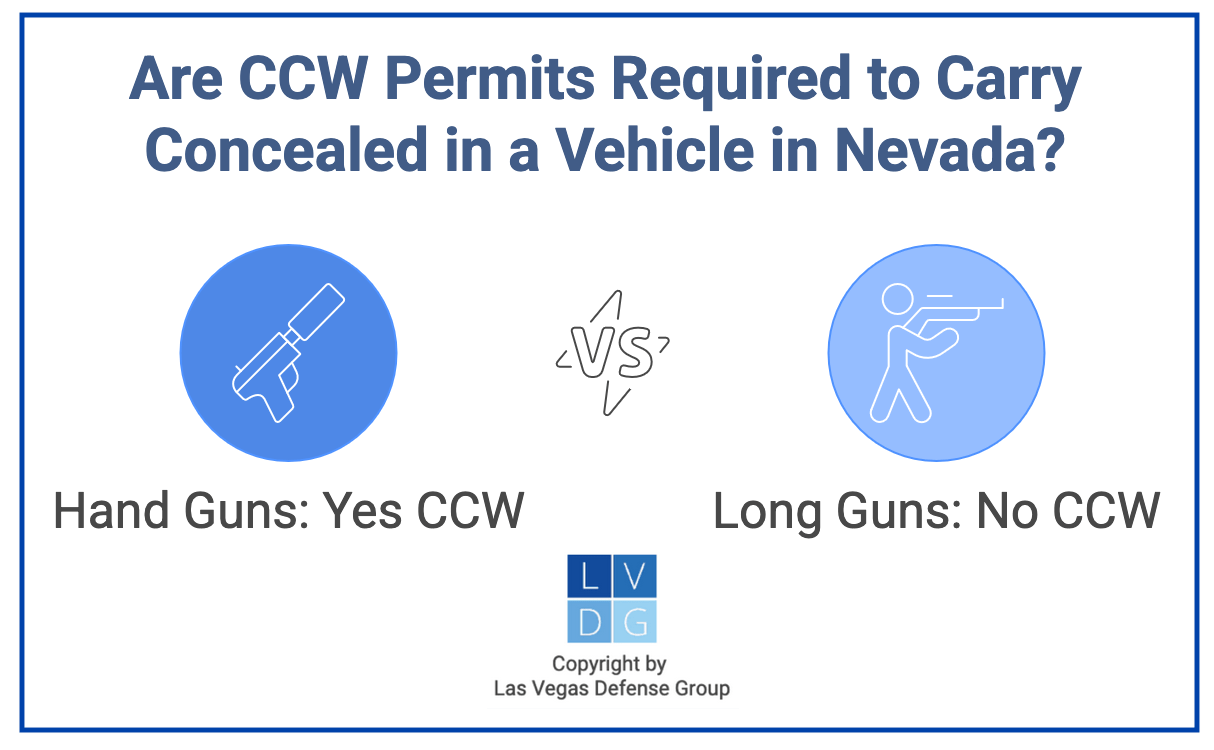
Below, I go into more detail about when and where you may carry guns in your vehicles in Nevada:
Driving with a Concealed Gun
To carry a concealed gun on your body while in a car in Nevada, you need a current and valid CCW permit. This includes guns hidden in purses, backpacks, or other items you are wearing. A gun is not considered concealed if your seat belt is only partly covering it.
If the gun is not on your body but hidden in the passenger area of the car, it would seem from the language of the statute that you do not need a CCW permit. However, gun instructors advise people to have a CCW before keeping a gun hidden in any “readily accessible” area of a car, such as:
- the glove box,
- the center console,
- a cup holder,
- under the seat, or
- under a blanket on the backseat or passenger seat.
If the gun is hidden in a locked trunk, in my experience, you probably do not need a CCW permit since it is not readily accessible.
Carrying a concealed firearm without a current and valid CCW permit is a category C felony in Nevada. The penalty includes:
- 1 to 5 years in Nevada State Prison and
- $10,000 in fines.2
Nevada is essentially an open carry state, and you do not need a permit to open carry. Learn more about background checks and reciprocity for concealed firearm permits (which currently includes Idaho, Arizona, Utah, and more).
Traffic Stops
If you are pulled over in Nevada, you have no duty to inform the police if there is a gun in the car. However, police may be able to perform a pat-down and seize a gun temporarily if the officer believes a crime has been committed or the officer’s safety is threatened.3
Note that as a CCW permit holder, you are required to show your permit if:
- you are carrying concealed, and
- the officer asks whether you are carrying concealed.4
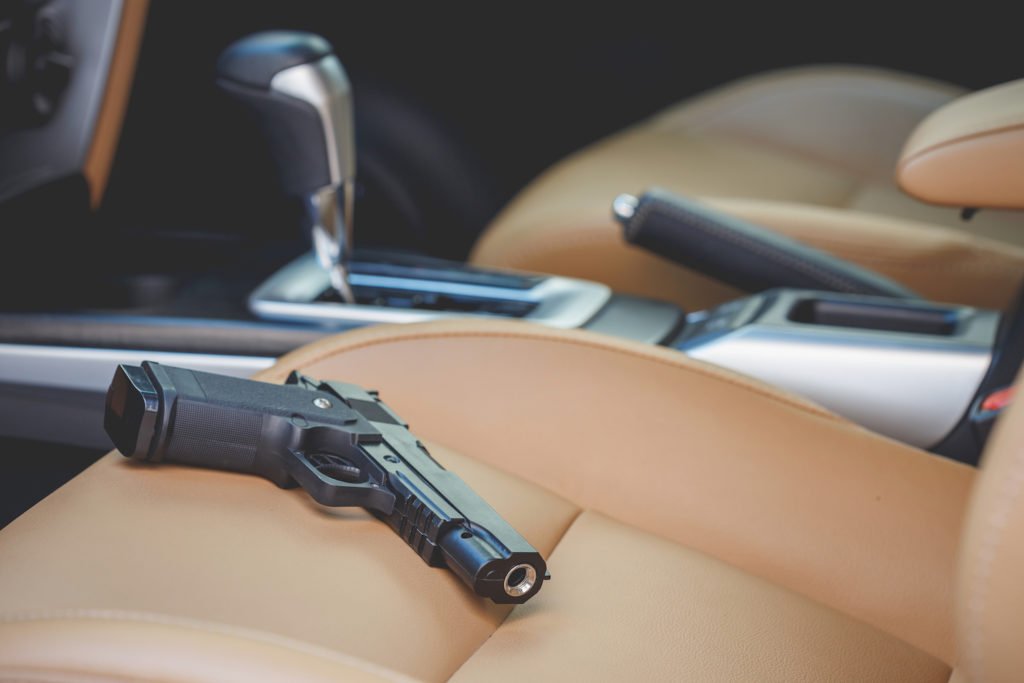
You may drive with loaded pistols and revolvers in your car in Nevada.
Guns in Company Cars
Private employers have their own rules about whether they allow guns on the premises, including in vehicles.
If you are an employee who violates these rules, you may not necessarily face criminal charges. However, the company may discipline you or terminate your employment.
Either way, if you travel with guns in your vehicle, you are encouraged to keep them in a locked compartment not visible to others and out of reach of children.
Guns on School Property
Nevada law prohibits guns, deadly weapons, and dangerous weapons at:
- public schools,
- colleges, and
- childcare facilities (with rare exceptions).
These locations are off-limits even if the guns are safely locked in a case in the car. It does not matter whether the gun is loaded or unloaded.
Violating this law is a gross misdemeanor charge, carrying:
- up to $2,000 in fines and/or
- up to 364 days in jail.5
Other Gun-Free Zones
In addition to public schools, colleges, and childcare facilities, you generally may not have guns at:
- post offices,
- federal facilities,
- VA facilities,
- legislative buildings,
- airport secure areas,
- airplanes, and
- Hoover Dam.6
Loaded handguns and loaded rifles are not allowed at Red Rock – magazines and clips cannot be inserted in the firearm, and rounds cannot be attached to the firearm.

It is a Nevada crime to shoot a gun from a vehicle.
Who Cannot Drive with Guns in Nevada
The following people are prohibited from possessing guns, whether in a vehicle or not:
- convicted felons,
- people convicted of domestic violence,
- people convicted of stalking a family member or intimate partner,
- people prohibited from having firearms according to a domestic violence restraining order,
- fugitives,
- drug users or addicts,
- anyone adjudicated mentally ill or committed to a mental health facility by a judge,
- people found not guilty due to insanity,
- people who pleaded – or were found – guilty but mentally ill,
- dishonorably discharged veterans,
- undocumented aliens, and
- people with a blood alcohol content of 0.08% or higher.
Note that minors under 18 years old usually may not carry loaded guns without supervision.7
Shooting a Gun from a Car
Shooting a gun from a car that is not within a lawfully recognized populated area in Nevada is a misdemeanor. The sentence includes a maximum of:
- 6 months in jail and/or
- $1,000 in fines.
If the vehicle is within a statutorily recognized populated area in Nevada, then shooting a gun from a car is a category B felony. The sentence includes:
- 1 to 10 years in prison and/or
- up to $5,000 in fines.8
Nevada’s Preemption Law
Nevada state gun laws preempt local laws.
However, localities such as counties, townships, and cities can lawfully regulate:
- the “unlawful discharge” of guns,
- gun carry by on-duty public employees, and
- zoning of gun stores and shooting ranges via general rules that apply to businesses.9
In general, you can openly carry guns in vehicles in Nevada.
Frequently Asked Questions
Do I need a CCW permit to keep a loaded handgun in my glovebox?
Technically, no. Nevada law only requires a Concealed Carry Weapon (CCW) permit if the firearm is concealed “upon your person.” However, because a glovebox or center console is immediately accessible, some law enforcement officers may treat it as a gray area. To be completely safe from concealed carry charges, it is highly recommended to either have a CCW permit or keep the gun in the trunk.
Can I drive with a loaded magazine in my rifle or shotgun?
Yes, but the firing chamber must be empty. Nevada law (NRS 503.165) specifically defines a loaded long gun as one with an unexpended cartridge or shell in the chamber. An attached, fully loaded magazine is perfectly legal as long as the chamber is clear.
Do I have to tell a police officer I have a gun in the car if I get pulled over?
Nevada does not have a general “duty to inform” law, meaning you don’t have to volunteer the fact that you have a firearm. However, if you are carrying concealed with a CCW permit and the officer explicitly asks, you are required to answer truthfully and present your permit and ID.
Can I keep a gun locked in my car while parked at a casino or hotel?
Yes, generally. Casinos and hotels are private property and have the right to ban firearms inside their buildings (doing so and refusing to leave can result in a trespassing charge). However, keeping a firearm securely locked and out of sight inside your personal vehicle in the parking garage is common practice and generally allowed.
Can I keep my gun in the car when dropping my kids off at school?
No. Under NRS 202.265, it is illegal to have a firearm on the property of a public or private school or childcare facility. This applies even if you stay in the car and the gun is locked in the trunk, unless you have received prior written permission from the school’s principal or designated official.
Helpful Resources
- Nevada Attorney General
- Nevada Legislature
- Nevada peace officer and sheriff departments
- Clark County Shooting Complex (rules for firearm safety and discharge of firearms)
- United States ATF (a federal law enforcement agency)
- Second Amendment (right to bear arms)
Additional Reading
For more in-depth information, refer to these scholarly articles:
- What’s Going Wrong in Nevada? A Comparative Analysis of California and Nevada Gun Control Laws as They Relate to Gun Violence – Claremont McKenna thesis
- State gun laws and the movement of crime guns between states – International Review of Law and Economics
- Guns in the Sky: Nevada’s Firearm Laws, 1 October, and Next Steps – Nevada Law Journal forum
- In-State and Interstate Associations Between Gun Shows and Firearm Deaths and Injuries – Annals of Internal Medicine
- The relation between state gun laws and the incidence and severity of mass public shootings in the United States, 1976–2018 – Law and Human Behavior
Legal References
- NRS 503.165. See also Cocking v. State (2025) No. 567 P.3d 348.
- NRS 202.350.
- NRS 171.123.
- NRS 202.3667.
- NRS 202.265.
- NRS 218A.905; NRS 202.265; 38 CFR 1.218(13); 39 CFR 232.1(l); 18 USC 930; 54 USC 104906; 49 CFR 1540.111; 49 USC 46505; 43 CFR 423.30.
- NRS 202.360; 18 USC 921(a)(33); NRS 202.300.
- NRS 202.287. See, for example, Powell v. State (1997) 113 Nev. 258.
- NRS 268.418.
