

Colorado Revised Statute § 18-9-116.5 C.R.S. prohibits vehicular eluding, which is driving recklessly while attempting to evade the police. This offense is a felony punishable by one to 12 years in prison depending on whether someone gets injured or killed.
The C.R.S. 18-9-116.5 states that:
“Any person who, while operating a motor vehicle, knowingly eludes or attempts to elude a peace officer also operating a motor vehicle, and who knows or reasonably should know that he or she is being pursued by said peace officer, and who operates his or her vehicle in a reckless manner, commits vehicular eluding.”

In this article, our Denver criminal defense lawyers will address the following key issues regarding felony vehicular eluding in Colorado law:
- 1. Elements of C.R.S. 18-9-116.5
- 2. Penalties
- 3. Defenses
- 4. Immigration Consequences
- 5. Record Seals
- Frequently Asked Questions
- Additional Reading
1. Elements of C.R.S. 18-9-116.5
For you to be convicted of vehicular eluding in Colorado, prosecutors have the burden to prove beyond a reasonable doubt the following three elements of the crime:
- You know – or reasonably should know – that an officer in a vehicle is pursuing you;
- You knowingly elude – or attempt to elude – the officer; and
- You are operating the vehicle in a reckless manner.1
Reckless driving means operating an automobile in wanton or with a willful disregard for the safety of others. Examples of reckless driving may include:
- driving twice the speed limit or faster,
- driving against traffic,
- driving over a center median to make a quick U-turn,
- driving off-road, or
- swerving between lanes in heavy traffic.2
High-speed police chases typically result in vehicular eluding charges. Note that you can face vehicular eluding charges even if the reckless driving occurred before or after the eluding (or attempted eluding) occurred. Reckless driving and eluding do not necessarily have to happen at the same time.3
Also note that vehicular eluding is a separate crime from eluding a police officer (C.R.S. 42-4-1413). Unlike vehicular eluding, eluding a police officer requires that the police be in a marked car and signal you to pull over. Plus you can face charges for eluding a police officer without driving recklessly.
Example: Stephanie is driving with a broken taillight through a residential neighborhood in Denver. Soon a marked police car signals for her to pull over. Panicking, Stephanie floors the gas pedal, causing the police to give chase. Stephanie would have crashed into other drivers and pedestrians had they not swerved out of the way in time.
Here, Stephanie can be convicted of both vehicular eluding as well as eluding a police officer: Vehicular eluding because she drove recklessly, and eluding a police officer because the police car was marked and signaled her to pull over.4
2. Penalties
Colorado’s punishment for vehicular eluding depends on whether anyone was injured in the incident, as the following table shows:
|
Vehicular Eluding |
Colorado Sentence |
| Incident caused no bodily injury | Class 5 felony: 1 to 3 years in Colorado State Prison and/or $1,000 to $100,000 |
| Incident caused bodily injury | Class 4 felony: 2 to 6 years prison and/or $2,000 to $500,000 |
| Incident caused death | Class 3 felony: 4 to 12 years in prison and/or $3,000 to $750,0005 |

Vehicular eluding is a felony in Colorado.
3. Defenses
Here at Colorado Legal Defense Group, we have represented countless people charged with vehicular crimes including eluding. In our experience, the following three defenses have proven very effective with prosecutors, judges, and juries at getting C.R.S. 18-9-116.5 charges reduced or dismissed.
- You honestly did not know – and had no reason to know – that you were being pursued by police.
- You did not drive recklessly at any point.
- You were not attempting to elude the police officer, and you pulled over as soon as it was reasonably safe to do so.
4. Immigration Consequences
Eluding a police car is a deportable offense because courts consider it a crime involving moral turpitude.6 Any non-citizen charged with this or other removable offenses should seek out an experienced attorney. The attorney may be able to convince prosecutors to dismiss or reduce the charges. Learn more about the criminal defense of immigrants in Colorado.
5. Record Seals
Whether you can get your C.R.S. 18-9-116.5 case sealed from your Colorado criminal record depends on the specific charge, as the following table shows:
|
Vehicular Eluding Conviction |
Record Seal Wait Time in Colorado |
| Class 5 felony (no bodily injury) | Three years after the case ends. |
| Class 4 felony (bodily injury) | Three years after the case ends. |
| Class 3 felony (fatality) | Never. The conviction remains on the record forever. |
Note that charges that get dismissed may be sealed immediately.7 Learn how to seal Colorado criminal records.
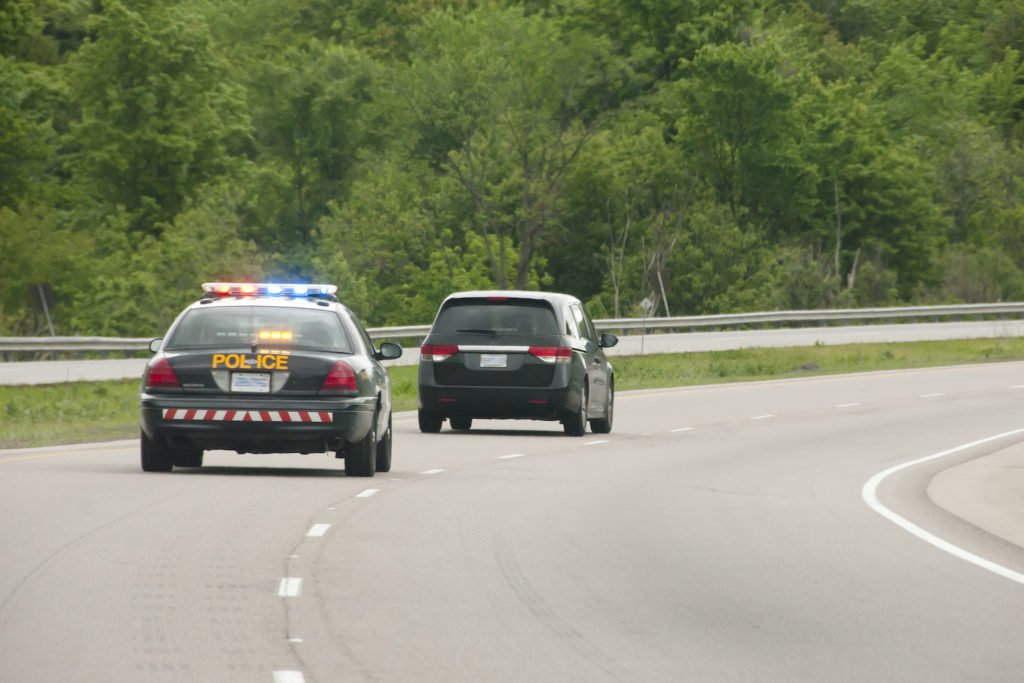
C.R.S. 18-9-116.5 forbids driving recklessly and eluding a police car.
Frequently Asked Questions
What makes eluding a felony instead of a misdemeanor in Colorado?
The “threshold” for a felony charge under C.R.S. 18-9-116.5 is reckless driving. If you simply fail to pull over or increase your speed to avoid a marked police car, you may be charged with a class 2 misdemeanor. However, if the prosecution can prove you drove in a “wanton or willful disregard for the safety of others” while fleeing, it escalates to vehicular eluding, which is a felony.
Does the police car have to be marked for a felony eluding charge?
No. Unlike the misdemeanor statute, C.R.S. 18-9-116.5 does not explicitly require the police vehicle to be marked with decals. The law only requires that you “know or reasonably should know” you are being pursued by a peace officer also operating a motor vehicle. If the officer is in an unmarked car but has activated emergency lights and sirens, you can still face felony charges.
Will I lose my driver’s license if convicted?
Yes. Under C.R.S. 42-2-125, a conviction for felony vehicular eluding triggers a mandatory revocation of your driver’s license by the Colorado DMV for at least one year. If you hold a commercial driver’s license (CDL), a felony conviction involving a motor vehicle is a “major offense” that will result in a CDL disqualification for at least one year, even for a first offense.
Can I be charged if I was just looking for a safe place to pull over?
Yes, police often overcharge in these scenarios. A common defense is “lack of intent.” If you maintained a safe speed, used your turn signal, and were clearly looking for a well-lit or safe area to stop rather than trying to escape, your attorney can argue that you were not “knowingly eluding” the officer.
Additional Reading
For more in-depth information, refer to these scholarly articles:
- Swimming against the Tide: The Eighth Circuit Holds That Fleeing a Police Officer in a Motor Vehicle is Not a Crime of Violence – Missouri Law Review.
- The Policeman’s Privilege to Shoot a Fleeing Suspect: Constitutional Limits on the Use of Deadly Force – American Criminal Law Review.
- Per Se Reasonable Suspicion: Police Authority to Stop Those Who Flee from Road Checkpoints – Duke Law Journal.
Legal References
- C.R.S. 18-9-116.5. HB 23-1293. See also People v. McMinn (Colo. App. 2013) 412 P.3d 551.
- C.R.S. 14-4-1401; See also People v. Pena (Colo. App. 1997) 962 P.2d 285; People v. Esparza-Treto (Colo. App. 2011) 282 P.3d 471 (reckless driving is a lesser-included offense of vehicular eluding).
- People v. Sherwood (Colo. App. 2000) 5 P.3d 956.
- C.R.S. 14-4-1413; see cases in note 2.
- C.R.S. 18-9-116.5.
- Matter of Ruiz-Lopez (BIA 2011) 25 I&N Dec. 551; 8 USC 1227.
- C.R.S. 24-72-703–706.