
Colorado Revised Statute § 18-4-504 C.R.S. prohibits third-degree trespass, which is unlawfully entering or remaining on another’s property that is not enclosed or fenced.
Third-degree trespass is typically a petty offense in Colorado, carrying up to 10 days in jail and/or a fine of up to $300.
The following table compares the elements and penalties of Colorado’s three degrees of trespass crimes.
| Degree of Trespass | Code Section | Elements | Colorado Penalties |
| First Degree Trespass | C.R.S. 18-4-502 | Knowingly and unlawfully entering or remaining in a dwelling or entering a vehicle with intent to commit a crime therein. | Usually a class 1 misdemeanor, carrying up to 364 days in jail and/or $1,000.
Trespassing on an inhabited or occupied dwelling is a class 6 felony, carrying 1 to 18 months in prison (and 1 year of mandatory parole) and/or $1,000 to $100,000. |
| Second Degree Trespass | C.R.S. 18-4-503 | Unlawfully entering or remaining in enclosed premises, such as fenced areas, or common areas of hotels and apartment buildings. | Knowingly and unlawfully entering or remaining in a motor vehicle of another is a class 2 misdemeanor, carrying up to 120 days in jail and/or $750.
Trespassing on agricultural land with intent to commit a felony is a class 5 felony, carrying 1 to 3 years in prison and/or $1,000 to $100,000. Otherwise, this is a petty offense, carrying up to 10 days in jail and/or $300. |
| Third Degree Trespass | C.R.S. 18-4-504 | Unlawfully entering or remaining on the premises of another without permission, typically involving areas not enclosed or fenced. | Usually a petty offense, carrying up to 10 days in jail and/or $300.
Trespassing on agricultural land with intent to commit a felony is a class 5 felony, carrying 1 to 3 years in prison and/or $1,000 to $100,000. If the agricultural land had no fence securing the perimeter, this is a class 6 felony, carrying 1 to 1.5 years in prison and/or $1,000 to $100,000. |
In this article, our Denver criminal defense lawyers will address the following key issues regarding third-degree trespass in Colorado law.
- 1. Elements of C.R.S. 18-4-504
- 2. Penalties
- 3. Defenses
- 4. Record Seals
- Frequently Asked Questions
- Additional Reading
1. Elements of C.R.S. 18-4-504
For you to be convicted of third-degree trespass in Colorado, prosecutors have the burden to prove beyond a reasonable doubt that you unlawfully entered or remained in or upon the unfenced or unenclosed premises of another.1
Example: Paul and his girlfriend Ann enter a public park after hours (there are signs with the hours listed). They find a place in the shelter to “hang out.” The area is not enclosed by a fence, and the shelter is not enclosed with walls but is open other than a roof. Because the area is not enclosed or fenced, Paul and Ann can only be charged with third-degree trespass and not second-degree trespass.
If the area had been fenced off or the building was enclosed by walls, the charge would have been for second-degree trespass.
For purposes of C.R.S. 18-4-504, acting “unlawfully” means without permission or consent, whether express or implied, of the owner of the property.2
Therefore, if you had permission to be on the property, you could not have been on the property unlawfully unless you remained on the property after the initial consent had been taken away.
Example: Phoebe and Ross are neighbors and they don’t get along very well. One day, Ross comes onto Phoebe’s unfenced front yard to yell at her about the noise coming from the house. Phoebe orders Ross to get off of her lawn, but he refuses. Ross could be charged with third-degree trespass.
2. Penalties
Third-degree criminal trespass in Colorado is usually a petty offense, carrying:
- up to 10 days in jail and/or
- a fine of up to $300.
If you trespass on agricultural land with the intent to commit a felony, 3rd-degree trespass is a class 5 felony, carrying:
- 1 to 3 years in prison and/or
- a fine of $1,000 to $100,000.
However, if the agricultural land had no fence securing the perimeter, then trespass is a class 6 felony, carrying:
- 1 to 1.5 years in prison and/or
- a fine of $1,000 to $100,000.3
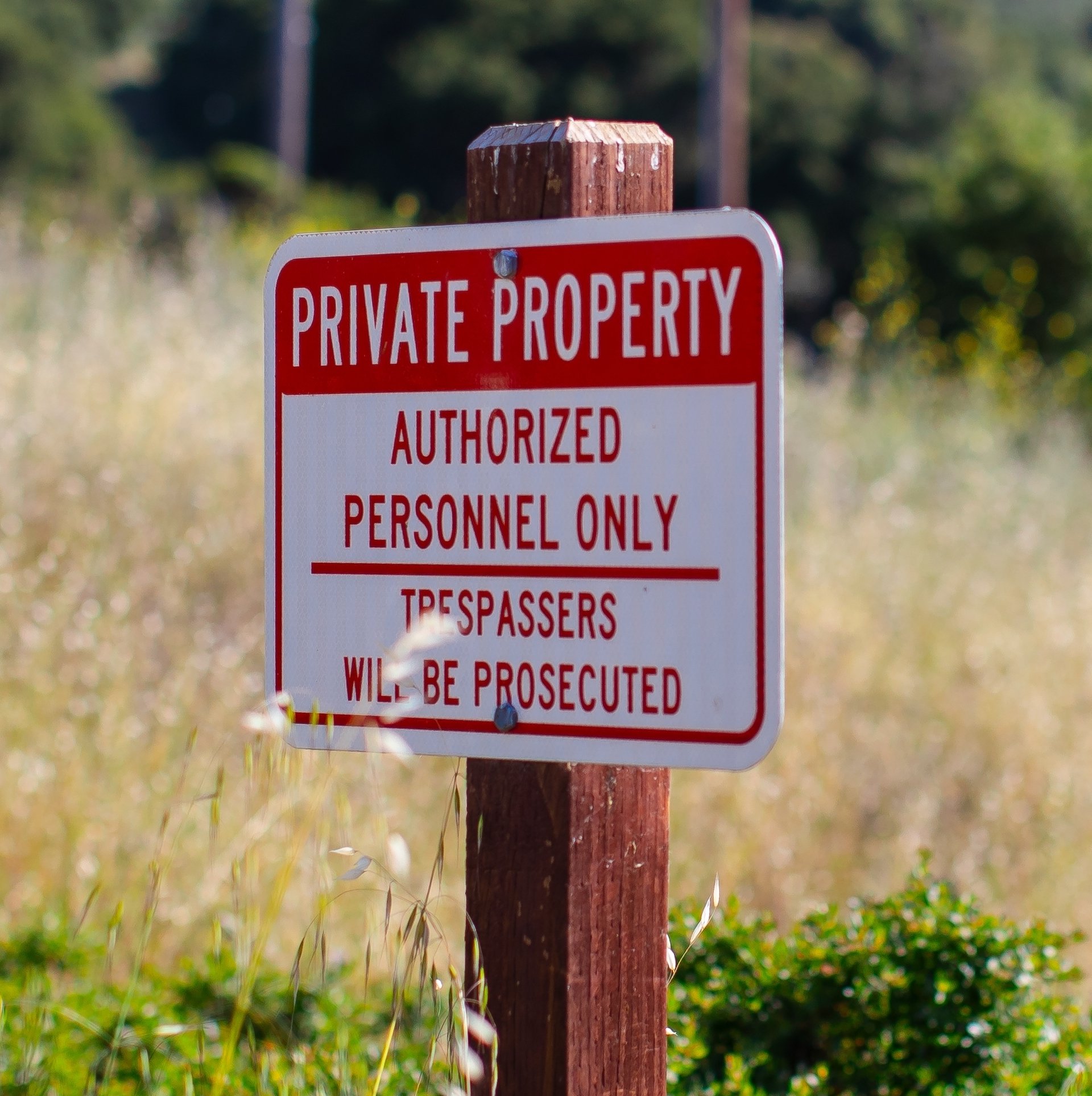
3rd-degree trespass in violation of CRS 18-4-504 is a Colorado petty offense.
3. Defenses
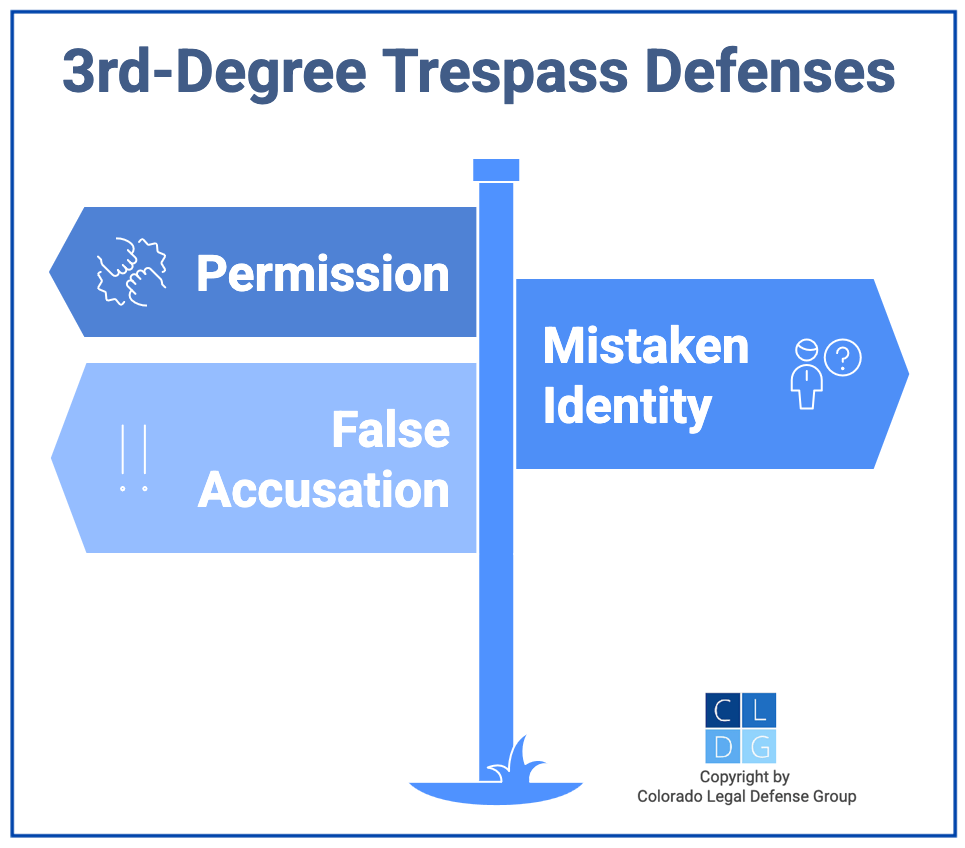
Here at Colorado Legal Defense Group, we have represented literally thousands of people charged with property crimes such as third-degree trespass. In our experience, the following four defenses have proven very effective with prosecutors, judges, and juries at getting C.R.S. 18-4-504 charges reduced or
- You had permission to be on the property;
- You were a victim of mistaken identification; or
- You were falsely accused.
Typical evidence in these cases includes recorded communications, GPS records, eyewitness accounts, and surveillance video.
4. Record Seals
A Colorado petty offense conviction of 3rd-degree trespass can be sealed one year after the case ends. Though as a felony conviction, 3rd-degree trespass can be sealed three years after the case ends.
Note that if your case gets dismissed, you can petition for a record seal immediately, no matter the original charge.4

Third-degree trespass involves trespassing on land or premises that are not enclosed or fenced.
Frequently Asked Questions
Is 3rd-degree criminal trespass a felony in Colorado?
Generally, no. Most cases are classified as a petty offense. However, it can be elevated to a class 6 felony if the trespass occurs on agricultural land with the specific intent to commit a felony. If that agricultural land is also secured by a fence, it is elevated further to a class 5 felony.
What is the difference between 2nd and 3rd-degree trespass?
The primary difference is the type of property involved. 2nd-degree trespass typically involves entering premises that are enclosed or fenced, or common areas of hotels and apartment buildings. 3rd-degree trespass usually involves open, unenclosed land (like a vacant lot or an unfenced field).
Can I be charged if there were no “No Trespassing” signs?
Yes. Under Colorado law, you do not necessarily need to see a sign to be charged. The prosecution only needs to prove that you “unlawfully” entered or remained on the property. While a lack of signage is a common defense, it is not an automatic “get out of jail free” card if it was clear the land belonged to someone else.
Will a conviction for 3rd-degree trespass stay on my record?
Yes, a conviction will appear on a criminal background check. However, because it is often a petty offense, you may be eligible to have the record sealed after a certain period (usually one year after the case is closed), provided you have no other pending charges.
Additional Reading
For more in-depth information, refer to these scholarly articles:
- Trespass, Crime and other Offenses a Venue Exception – Baylor Law Review.
- Trespass-Zoning: Ensuring Neighborhoods a Safer Future by Excluding Those with a Criminal Past – Notre Dame Law Review.
- Private Property and Public Order: The Hippy Convoy and Criminal Trespass – Journal of Law and Society.
- Larceny and Trespass – Law Quarterly Review.
- A Trespass Framework for the Crime of Hacking – George Washington Law Review.
Legal References:
- C.R.S. 18-4-504 – Third Degree Criminal Trespass.
Third degree criminal trespass.
(1) A person commits the crime of third degree criminal trespass if such person unlawfully enters or remains in or upon premises of another.
(2) Third degree criminal trespass is a petty offense, but:
(a) Repealed.
(b) It is a class 5 felony if the person trespasses on premises classified as agricultural land with the intent to commit a felony thereon; except that it is a class 6 felony if the agricultural land did not have a fence securing the perimeter.
C.R.S. 18-4-503. See C.R.S. 18-1-501(6). C.R.S. 18-4-504.5 (Definition of premises). See, for example, People v. Camp (Colo. 2025) 581 P.3d 763. - Same as 1.
- C.R.S. 18-4-504. Prior to March 1, 2022, 3rd-degree trespass was usually a class 1 petty offense, carrying up to 6 months in jail and/or up to $500 in fines. But 3rd-degree trespass became a class 3 misdemeanor if the premises had been classified by the county assessor as agricultural lands. Penalties included up to 6 months in jail and/or $50 to $750 in fines. SB21-271. HB 23-1293.
- C.R.S. 24-72-701-711.