

Colorado Revised Statute § 18-4-302 prohibits aggravated robbery, which is robbery involving a deadly weapon. This includes not only guns and knives but also any object that can be used to seriously injure someone.
As an extraordinary risk class 3 felony, aggravated robbery carries four to 16 years in Colorado State Prison with five years of mandatory parole and $3,000 to $750,000 in fines.
However, aggravated robbery will also be classified as a crime of violence if, during the robbery or while fleeing from it, you knowingly:
- wounded or struck a person with a deadly weapon or
- used force, threats, or intimidation to place a person in reasonable fear of death or bodily injury.
As a crime of violence, aggravated robbery carries a higher Colorado State Prison range of 10 to 32 years.
In this article, our Denver criminal defense lawyers will address the following key topics regarding aggravated robbery laws in Colorado:
- 1. Elements of C.R.S. 18-4-302
- 2. Deadly Weapons
- 3. Record Seals
- 4. Defenses
- 5. Related Offenses
- Frequently Asked Questions
- Additional Reading
1. Elements of C.R.S. 18-4-302
Aggravated robbery is also called “armed robbery.” For you to be convicted of aggravated robbery under C.R.S. 18-4-302, prosecutors must prove beyond a reasonable doubt that you used force, threats, or intimidation to steal something from someone (or in their presence) and either:
- You had a deadly weapon and the intent, if resisted, to kill, maim, or wound the person robbed; or
- You knowingly wounded or struck another person with a deadly weapon; or
- You used the deadly weapon to put another person in reasonable fear of death or bodily harm; or
- You represented that you were armed with a deadly weapon.1
Even if you were unarmed, you may still be convicted of aggravated robbery if your accomplice was armed.
In short, aggravated robbery requires the use or threat of a deadly weapon, while simple robbery cases do not.2
Example: Frank runs and snatches a purse from Fiona while she is shopping in downtown Denver. Frank can be convicted of robbery because he used force to take an item from another person. He did not use a weapon, so he would not be charged with aggravated robbery.
Example: Claire pulls a shotgun on Jonathan, who has just pulled out money from an ATM. She points the gun at him and threatens to shoot him if he does not give her the money. Claire can be charged with aggravated robbery because she used a deadly weapon to commit a robbery – which is an aggravating factor.

C.R.S. § 18-4-302 is the Colorado code section that prohibits aggravated robbery.
2. Deadly Weapons
Under Colorado aggravated robbery laws, “deadly weapons” comprise:
- firearms, whether loaded or unloaded,
- knives,
- bludgeons, or
- any other weapon or material, whether animate or inanimate, that, in the manner it is used or intended to be used, is capable of producing death or serious bodily injury.3
Therefore, nearly anything could qualify as a deadly weapon in a C.R.S. 18-4-302 case, depending on how it is used. Common examples include:
- hammers,
- grenades,
- metal pipes,
- screwdrivers,
- acid,
- baseball bats, or
- cars or other motor vehicles.
What if I lied about having a deadly weapon?
Even if you did not have a deadly weapon during the robbery, you can still be convicted of aggravated robbery in Colorado if either:
- You stated you possessed a deadly weapon, or
- You used an object that looks like a deadly weapon.4
Example: Dean approaches Sam while Sam is getting into his car after work. Dean has his finger in his pocket, pointing out in the shape of a gun to make it look like he is armed. Dean threatens to shoot Sam with his “gun” if Sam refuses to hand over his briefcase. Even though Dean never actually had a gun, he will still be charged with aggravated robbery.

Deadly weapons separate simple robbery from aggravated robbery.
3. Record Seals
Colorado aggravated robbery convictions can never be sealed from your criminal record. Though if your charge gets reduced to simple robbery, you can petition for a record seal three years after the case closes.
Note that if your case gets dismissed, there is no wait time to request a record seal.5
4. Defenses
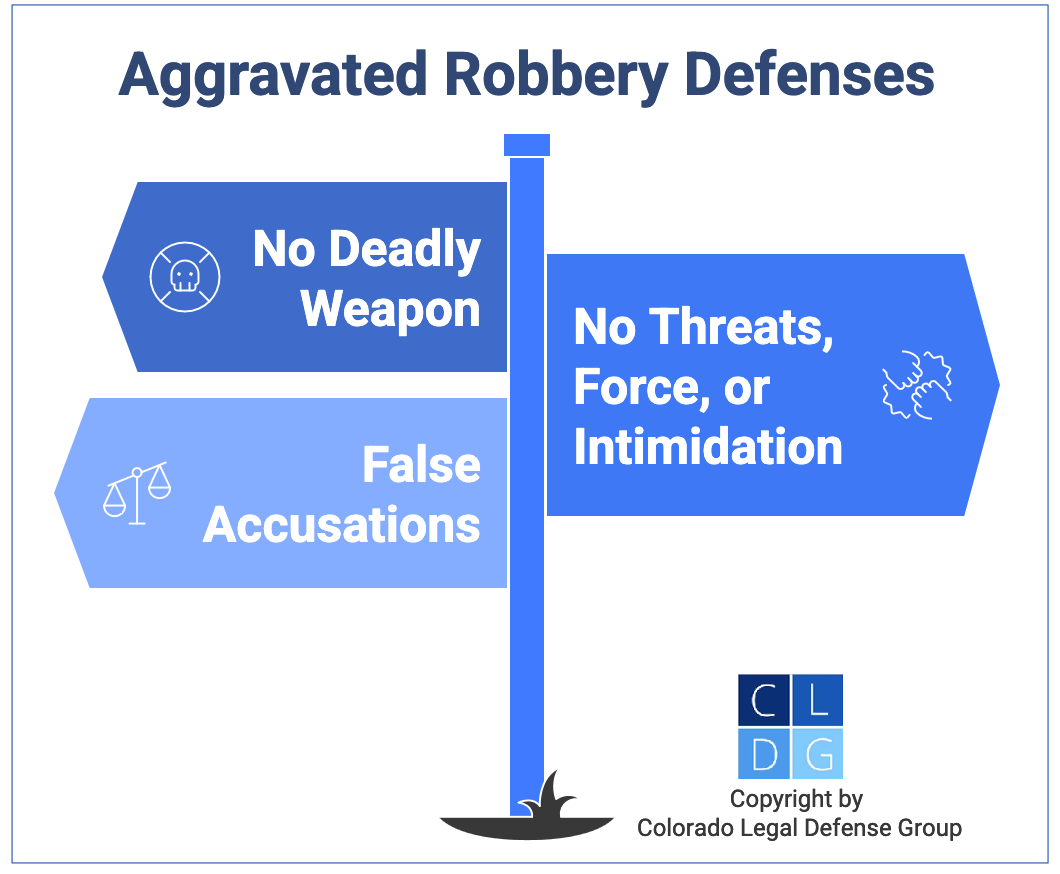
Here at Colorado Legal Defense Group, we have represented literally thousands of people charged with aggravated robbery. In our experience, the following four defenses can get a C.R.S. 18-4-302 charge reduced to simple robbery, larceny, or even a dismissal.
- You did not use or possess a deadly weapon during the incident; or
- You never claimed to have a deadly weapon during the incident; or
- You stole, but you used no threats, force, or intimidation; or
- You never committed a robbery, and you are being falsely accused.
Typical evidence in aggravated robbery cases includes video surveillance footage, eyewitness accounts, and GPS records.

Aggravated robbery is a serious felony in Colorado.
5. Related Offenses
- Simple robbery (C.R.S. 18-4-301)
- Burglary (C.R.S. 18-4-201)
- Possession of burglary tools (C.R.S. 18-4-205)
- Petty theft offense (C.R.S. 18-4-401)
- Misdemeanor theft (C.R.S. 18-4-401)
- Felony theft (C.R.S. 18-4-401)
- Menacing (C.R.S. 18-3-206)
Frequently Asked Questions
What if I did not have a weapon, but my accomplice did?
If you willingly participate in a robbery, and your co-defendant or accomplice is armed with a deadly weapon, the law holds you equally responsible. You face the same class 3 felony charges and mandatory sentencing as the person who actually held the weapon.
What is the statute of limitations for aggravated robbery in Colorado?
Because aggravated robbery is a felony, prosecutors typically have three years from the date the crime was committed to file charges against you. However, this three-year statute of limitations can be paused (tolled) for up to five years if you flee the state of Colorado or actively conceal yourself to avoid arrest.
Will a conviction for aggravated robbery affect my right to own a gun?
Yes. Aggravated robbery is a felony offense. Under both Colorado and federal law, convicted felons lose their constitutional right to purchase, own, or possess a firearm. If you are caught with a gun after a conviction, you can face additional felony charges for Possession of a Weapon by a Previous Offender (POWPO).
Can a juvenile be charged as an adult for aggravated robbery?
Yes. In cases where aggravated robbery is classified as a “crime of violence,” Colorado law allows prosecutors to try juvenile defendants as adults. If convicted in adult court, a minor can face the same severe adult prison sentences rather than juvenile detention.
Is it possible to get an aggravated robbery charge reduced or dropped?
Yes. A skilled defense attorney can often negotiate with the District Attorney to get charges reduced. If the prosecution’s evidence regarding the use of a “deadly weapon” is weak, or if there are issues with how the police conducted the lineup or witness identification, the charges might be reduced to simple robbery, felony theft, or menacing. In cases involving severe police misconduct or a solid alibi, the case could be dismissed entirely.
Can I get bail if I am arrested for aggravated robbery?
In most cases, yes, a judge will set bail. However, because aggravated robbery is classified as an extraordinary risk crime and is often a “crime of violence,” the judge is more likely to consider you a flight risk or a danger to the community. Consequently, the bail amount is usually set very high.
An attorney can file a motion for a bond reduction hearing to argue for a lower bail amount or release on your own recognizance (PR bond) with strict conditions like GPS monitoring.
Additional Reading
For more in-depth information, refer to the following scholarly articles:
- Robbery, Recidivism, and the Limits of the Criminal Justice System – Marquette Law Review.
- Gender and Robbery: A National Test – Deviant Behavior.
- Threats, Blackmail, Extortion and Robbery and Other Bad Things – Tulsa Law Journal.
- Store Robbery Policies — Their Coverage and Construction – Insurance Law Journal.
- Economic Analysis of Threats and Their Illegality: Blackmail, Extortion, and Robbery – University of Pennsylvania Law Review.
Legal References:
- Colorado Revised Statute § 18-4-302 – Aggravated Robbery.
(1) A person who commits robbery is guilty of aggravated robbery if during the act of robbery or immediate flight therefrom:
(a) He is armed with a deadly weapon with intent, if resisted, to kill, maim, or wound the person robbed or any other person; or
(b) He knowingly wounds or strikes the person robbed or any other person with a deadly weapon or by the use of force, threats, or intimidation with a deadly weapon knowingly puts the person robbed or any other person in reasonable fear of death or bodily injury; or
(c) He has present a confederate, aiding or abetting the perpetration of the robbery, armed with a deadly weapon, with the intent, either on the part of the defendant or confederate, if resistance is offered, to kill, maim, or wound the person robbed or any other person, or by the use of force, threats, or intimidation puts the person robbed or any other person in reasonable fear of death or bodily injury; or
(d) He possesses any article used or fashioned in a manner to lead any person who is present reasonably to believe it to be a deadly weapon or represents verbally or otherwise that he is then and there so armed.
See, for example: People v. Firm (Colo.App. 2014) 342 P.3d 537; O’Shaughnessy v. People (Colo. 2012) 269 P.3d 1233; People v. Gregg (Colo. App. 2011) 298 P.3d 983; Sellers v. People (2024) Supreme Court Case No. 22SC738; People v. Reese (Colo. 2006) 155 P.3d 477 (stating the proof required to prove the offense of aggravated robbery); People v. Ali (Colo.App. 2025) No. 22CA2109. - Same.
- C.R.S. § 18-1-901. (Definitions).
- C.R.S. § 18-4-302(1)(d).
- C.R.S. 24-72-701–711.