
Colorado Revised Statute 18-6-701 C.R.S. prohibits contributing to the delinquency of a minor. This crime comprises inducing, aiding or encouraging a child under 18 “to violate any federal or state law, municipal or county ordinance, or court order.”
Examples of contributing to the delinquency of a minor include:
- Ordering a child to vandalize and burglarize the home of a neighbor you dislike,
- Keeping a child home from school (“truant“) for no reason,
- Asking a child to deliver marijuana, cocaine, or other drugs to someone else, or
- Daring a child to shoplift.
In this article, our Denver criminal defense attorneys will address the following key issues regarding contributing to the delinquency of a minor in Colorado.
1. First Degree
First-degree contributing to the delinquency of a minor is inducing a child under 18 to commit any Victims Rights Act (VRA) felony listed in C.R.S. 24-4.1-302. Some of these crimes include:
- Indecent exposure (C.R.S. 18-7-302);
- Robbery (C.R.S. 18-4-301); or
- Procurement of a child for sexual exploitation (C.R.S. 18-6-404).
First-degree contributing to the delinquency of a minor is a class 4 felony in Colorado. The sentence includes:
- 2 to 6 years in Colorado State Prison and/or
- $2,000 to $500,000 in fines.
It may be possible to persuade the court to grant probation instead of prison.1
Note that if you are a Colorado School District employee or licensed teacher, and if you get convicted of, plead no contest to, or get a deferred sentence for contributing to the delinquency of a minor, the court will report you to the Colorado Department of Education. Your name may end up on the Department of Human Services (DHS) Trails list database. This may cause you to lose your license and your job.2
2. Second Degree
Second-degree contributing to the delinquency of a minor in Colorado is inducing a child to violate any municipal or county ordinance, court order, or state or federal law that is not listed in C.R.S. 24-4.1-302. Examples include encouraging a child to pollute, loiter, or trespass.
Second-degree contributing to the delinquency of a minor is a class 1 misdemeanor. The punishment is up to 364 days in jail and/or up to $1,000 in fines. It is not unusual for judges to grant probation rather than impose incarceration.
As with 1st-degree cases, Colorado School District staffers who get convicted of, plead no contest to, or get a deferred sentence for 2nd-degree contributing to the delinquency of a minor face job- and license loss.3
3. Defenses
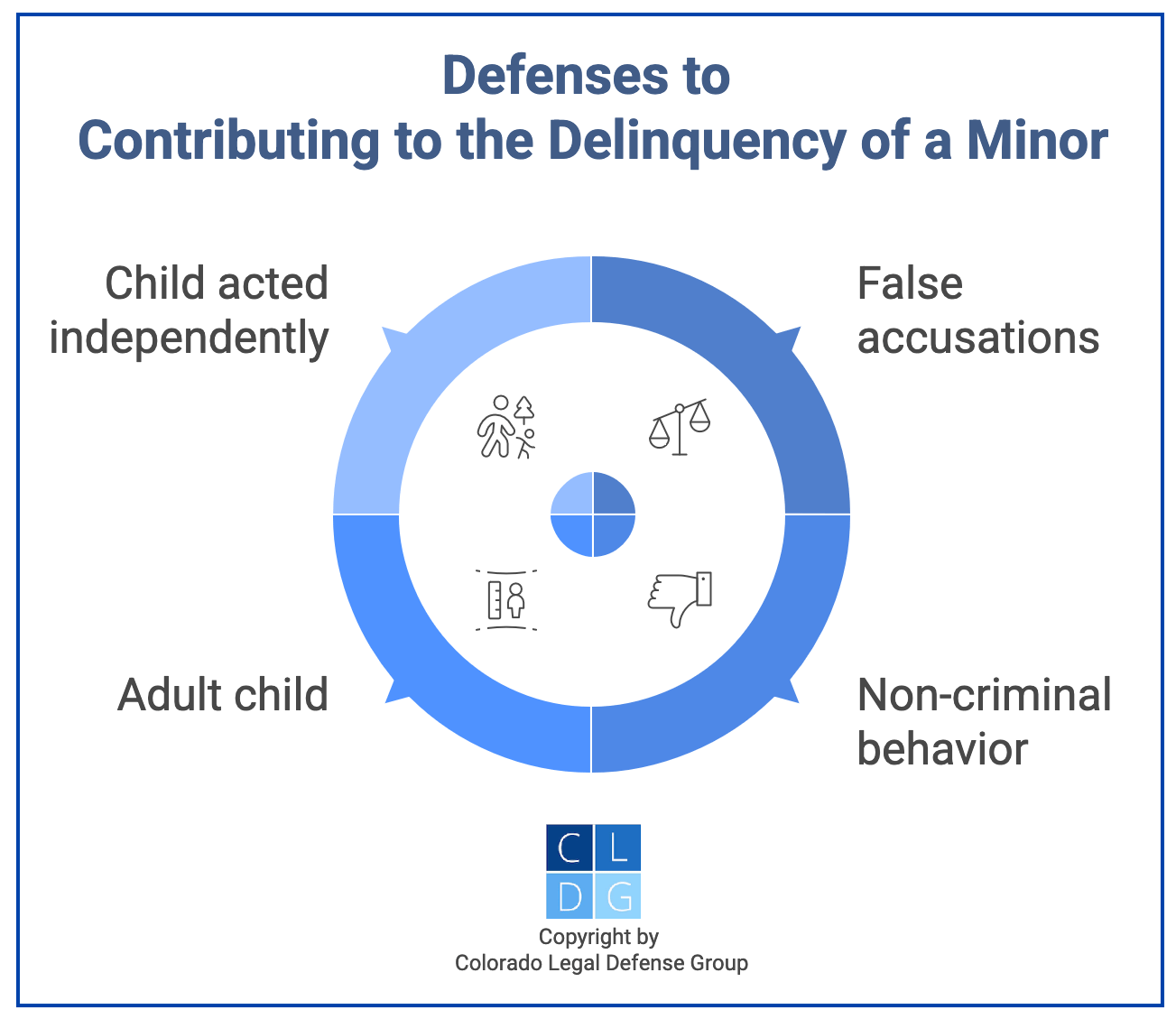
Here at Colorado Legal Defense Group, we have represented literally thousands of people charged with crimes involving children, including contributing to the delinquency of a minor. In our experience, the following four defenses have proven very effective with prosecutors, judges, and juries at getting C.R.S. 18-6-701 charges reduced or dismissed.
- The charge is based on false accusations; or
- Your behavior fell short of contributing to delinquency; or
- The child was at least 18 years old (or you reasonably believed they were); or
- The child acted outside of your control.4
As with every criminal case, the D.A. has the burden to prove every element of the crime beyond a reasonable doubt – which is a very high bar. Therefore, prosecutors are often willing to negotiate a favorable plea bargain.

Everything from paying a child to threatening a child is illegal if your purpose is to get the child to commit a crime.
4. Frequently Asked Questions
What is the difference between 1st-degree and 2nd-degree contributing to the delinquency of a minor?
The degree depends on the severity of the crime you allegedly encouraged the minor to commit.
You face 1st-degree charges (a class 4 felony) if you induce a minor to commit a felony Victims Rights Act (VRA) crime, such as robbery or assault.
You face 2nd-degree charges (a class 1 misdemeanor) if you encourage a minor to violate a municipal ordinance, a court order, or a non-felony law, such as trespassing, loitering, or breaking curfew.
Can I be convicted if I genuinely believed the minor was 18 or older?
Not necessarily. Colorado law allows for an “affirmative defense” in these cases. If your defense attorney can prove that you had a reasonable belief that the individual was 18 years of age or older at the time of the incident, it can serve as a legal justification and potentially lead to a dismissal of the charges.
Does the minor actually have to commit the crime for me to be charged?
No. Under C.R.S. 18-6-701, the crime is inducing, aiding, or encouraging a child to violate a law. You can be arrested and convicted for the act of encouraging or commanding the minor to do something illegal, even if the minor refuses to do it or gets caught before they can carry it out.
Is providing alcohol or marijuana to a teenager considered “contributing to the delinquency of a minor”?
While providing restricted substances to a minor is unlawful, it is generally prosecuted under separate, specific Colorado statutes rather than C.R.S. 18-6-701.
Furnishing alcohol to a minor is charged under C.R.S. 44-3-901, and providing marijuana to a minor is prosecuted under C.R.S. 18-18-406. Giving cigarettes or tobacco products is also a separate offense (C.R.S. 18-13-121).
How will this charge affect my job if I work in a school?
A conviction can be career-ending for educators. If you are a licensed teacher or an employee of a Colorado School District, the court is legally obligated to report your case to the Colorado Department of Education if you are convicted, plead no contest (nolo contendere), or accept a deferred sentence.
You may be placed on the Department of Human Services (DHS) Trails database, which can result in the revocation of your teaching license and immediate termination.
Can a “Contributing to the Delinquency of a Minor” conviction be sealed from my record?
If the charges against you are dismissed, you can petition to seal the record immediately. If you are convicted, you generally must wait three years after completing your sentence to petition for sealing.
5. Additional Reading
If you are a child in immediate danger or know one who is, call 911. Otherwise, contact the Colorado Child Abuse and Neglect Hotline at 844-CO-4-Kids to report abuse or neglect.
See our related articles on the following crimes and topics:
- Furnishing alcohol to a minor (C.R.S. 44-3-901)
- Giving cigarettes to a minor (C.R.S. 18-13-121)
- Permitting an unauthorized minor to drive (C.R.S. 42-2-139)
- Contributing to the delinquency of a minor – What does it mean?
Legal References
- C.R.S. 18-6-701 – Contributing to the delinquency of a minor.
(1) (a) Any person who induces, aids, or encourages a child to violate any state law that is a felony victims rights act crime as defined in section 24-4.1-302 (1) commits first degree contributing to the delinquency of a minor.
(b) Any person who induces, aids, or encourages a child to violate any municipal or county ordinance, court order, or state or federal law that is not a felony victims rights act crime as defined in section 24-4.1-302 (1) commits second degree contributing to the delinquency of a minor.
(c) As used in this section, the term “child” means any person under the age of eighteen years.
(2) (a) First degree contributing to the delinquency of a minor is a class 4 felony.
(b) Second degree contributing to the delinquency of a minor is a class 1 misdemeanor.
(3) When a person is convicted, pleads nolo contendere, or receives a deferred sentence for a violation of the provisions of this section and the court knows the person is a current or former employee of a school district in this state or holds a license or authorization pursuant to the provisions of article 60.5 of title 22, C.R.S., the court shall report such fact to the department of education.See also People v. Miller (Colo. App. 1991) 830 P.2d 1092. Note that giving marijuana to a minor is a separate offense under C.R.S. 18-18-406; See People v. Graybeal (Colo. App. 2007) 155 P.3d 614. See People v. Valdez (Colo. App. 2026) No. 24CA0540. Prior to March 1, 2022, contributing to the delinquency of a minor was not divided into degrees, and it was always a felony. SB21-271. - C.R.S. 18-6-701. The felony crimes defined in C.R.S. 24-4.1-302 are:
- Murder in the first degree (C.R.S. 18-3-102);
- Murder in the second degree (C.R.S. 18-3-103);
- Manslaughter (C.R.S. 18-3-104);
- Criminally negligent homicide (C.R.S. 18-3-105);
- Vehicular homicide (C.R.S. 18-3-106);
- Assault in the first degree (C.R.S. 18-3-202);
- Assault in the second degree (C.R.S. 18-3-203);
- Vehicular assault (C.R.S. 18-3-205);
- Menacing (C.R.S. 18-3-206);
- First degree kidnapping (C.R.S. 18-3-301);
- Second degree kidnapping (C.R.S. 18-3-302);
- Sexual assault (C.R.S. 18-3-402);
- Unlawful sexual contact (C.R.S. 18-3-404);
- Sexual assault on a child (C.R.S. 18-3-405);
- Sexual assault on a child by one in a position of trust (C.R.S. 18-3-405.3);
- Sexual assault on a client by a psychotherapist (C.R.S. 18-3-405.5);
- Invasion of privacy for sexual gratification (C.R.S. 18-3-405.6);
- Robbery (C.R.S. 18-4-301);
- Aggravated robbery (C.R.S. 18-4-302);
- Aggravated robbery of controlled substances (C.R.S. 18-4-303);
- Incest (C.R.S. 18-6-301);
- Aggravated incest (C.R.S. 18-6-302);
- Child abuse (C.R.S. 18-6-401);
- Sexual exploitation of children (C.R.S. 18-6-403);
- Crimes against at-risk adults or at-risk juveniles (C.R.S. 18-6.5-103);
- Any crime identified by law enforcement prior to the filing of charges as domestic violence, as defined in C.R.S. 18-6-800.3 (1);
- An act identified by a district attorney in a formal criminal charge as domestic violence, as defined in C.R.S. 18-6-800.3 (1);
- Any crime, the underlying factual basis of which has been found by the court on the record to include an act of domestic violence, as defined in C.R.S. 18-6-800.3 (1), pursuant to C.R.S. 18-6-801 (1);
- Stalking (C.R.S. 18-3-602);
- A bias-motivated crime (C.R.S. 18-9-121);
- Failure to stop at the scene of an accident (C.R.S. 42-4-1601), where the accident results in the death or serious bodily injury of another person;
- Retaliation against a witness or victim (C.R.S. 18-8-706);
- Intimidating a witness or a victim (C.R.S. 18-8-704);
- Aggravated intimidation of a witness or a victim (C.R.S. 18-8-705);
- Tampering with a witness or victim (C.R.S. 18-8-707);
- Indecent exposure (C.R.S. 18-7-302);
- Human trafficking (C.R.S. 18-3-504);
- Sex trafficking (C.R.S. 18-3-504);
- First degree burglary (C.R.S. 18-4-202);
- Second degree burglary of a dwelling (C.R.S. 18-4-203 (2)(a));
- Retaliation against a judge or elected official (C.R.S. 18-8-615);
- Retaliation against a prosecutor (C.R.S. 18-8-616);
- Retaliation against a juror (C.R.S. 18-8-706.5);
- Child prostitution (C.R.S. 18-7-401);
- Soliciting for child prostitution (C.R.S. 18-7-402);
- Procurement of a child for sexual exploitation (C.R.S. 18-6-404);
- Pimping of a child (C.R.S. 18-7-405);
- Inducement of child prostitution (C.R.S. 18-7-405.5);
- Patronizing a prostituted child (C.R.S. 18-7-406); and/or
- Any criminal attempt (C.R.S. 18-2-101), any conspiracy (C.R.S. 18-2-201), any criminal solicitation (C.R.S. 18-2-301), and any accessory to a crime (C.R.S. 18-8-105), involving any of the aforementioned offenses.
- C.R.S. 18-6-701.
- People v. Hastings (Colo. App. 1999) 983 P.2d 78.